Showing posts with label funny picture. Show all posts

Tuesday, June 11, 2013

My Favorite NPC - Balthazar

Hey, readers!

So, I'm a part of an organization now called the Role-Playing Blog Alliance which is sort of a centralized hub for blogs about the hobby which gives you free advertising and stuff. It's pretty cool. One of the things I noticed on there was something called a 'Blog Carnival' where a blog puts up a topic and everyone that wants to makes a post about that topic.

In the interest of ranting about random topics, as I thoroughly enjoy doing, I decided to throw my hat into the ring!

This month's topic is 'My Favorite NPC.' Now, as someone with near Perma-GM syndrome, this is kind of tricky, because I haven't really played in games long enough to find an NPC that I really, truly enjoyed interacting with. Not to say that there haven't been some great ones, but none that I would elevate to the status of 'My Favorite'.

Of course, I could just be a derp and maybe this topic also includes NPC's you've created and ran, but I digress.

I'm going to cheat a little.

The first D&D campaign that I ran in college was a real treat to run, and at some point I'll probably elaborate more on it, but there came a time where I really wanted to play. So, a friend of mine said that she wouldn't mind running the game for a while and we changed guard. The NPC I am going to describe first showed up during the segment where I was playing, but I decided to bring him back and make him an important part of the plot when I got back in the GM chair after my character's touching death via sacrifice.

Without further ado, let me introduce you all to...

Balthazar


Origin:

Balthazar's origin came at a time where a lot of my player's wanted a nemesis of some kind. My friend Harry, who was playing a Samurai, wanted to have an Oni that killed his mother involved in the plot somewhere, so I allowed that for a bit. Then, my friend Jean, who was playing a Revenant Assassin in service to the Raven Queen, wanted a nemesis of his own. I didn't get a lot of details other than a name, and that he was a former Assassin of the Raven Queen who left the order.

My friend Ellen took the game over for a bit while her character was trapped in a pocket dimension. Fun, right? Well, anyway, she first introduced the character as someone who was working with a mysterious figure known as 'The Occultist' who worked for the bad guys. He didn't have a lot of depth, just a bad-ass Eladrin assassin leading a twisted family of monstrous freaks. We didn't see too much of him.

When I got the reins back, I decided that Jean's nemesis didn't get enough screen time, so the wheels in my head started to turn, and I planted him at a most inopportune moment as a sort of off-the-cuff, unplanned way to prevent my party from doing something nearly suicidal. They were about to go kill a dragon on top of a mountain, who had a macguffin and was also the creator of the Dragonborn in my world. Only one problem, though. If a Dragonborn is hit by this dragon's fire, they turn into ash instantly, since that was the fire that created them. We had two Dragonborn in the party, too, so this was potentially going to be a disaster.

So, there to warn them about the dragon's fire and tell them that there's a way to make the fight much easier was Balthazar. Now, I'm an impressionist, so I enjoy doing cool, strange voices for my NPCs/characters. Somehow or other, by fate or chance, the more I talked as Balthazar, the more he started to sound like a certain celebrity. Not a particularly famous celebrity, mind you, but one that is close to my heart.

John de Lancie.

(I actually met him and shook his hand!!)

And, thus, Balthazar was born.

Appearance:

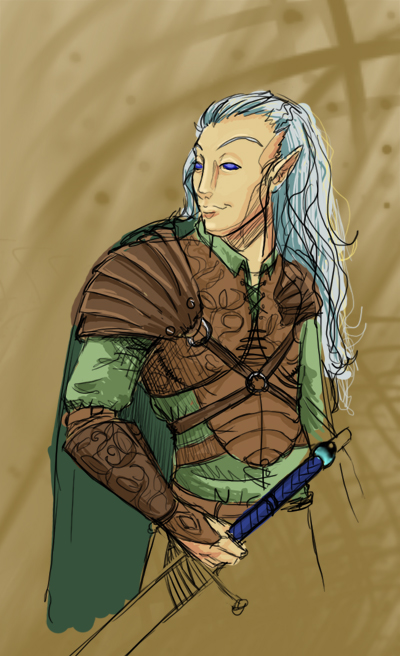
So, Balthazar is an Eladrin in a world where most of the Eladrin were corrupted into Orcs for messing with the Gods and the ones that remained had some weird sort of destiny. As such, he looks like an elf pretty much, tall and lanky with the pointed ears. Except, I picture him as a little taller and lankier than most, almost skeletal in his appearance but he tries to hide that with his clothing and mannerisms. Long silvery hair cascades down his features, very fine with an almost glittering quality to it. Since Eladrin are practically immortal, or else incredibly long lived, he still has a youthful face, but his piercing blue eyes carry the weight of a thousand years.

Personality:

This is where Balthazar becomes fun. Since the voice started to sound like John de Lancie, I decided to go full-out impressionist and mimic his voice, which lends itself obviously to the 'Q'-like mannerisms. In almost an instant, this originally rather flat NPC became someone the party loved to hate. He always had a snide comment, a taunting air of superiority with a twinge of boredom because, after living so long, he has experienced almost everything. Balthazar is a man looking for his destiny that was apparently promised to him by the Gods, and his search has brought him into almost every profession and walk of life to no avail. He possesses an Ecclestiastian mentality that everything is meaningless in the view of mortality and death, and there is nothing he loves more than tearing down the hopes and beliefs of those around him, playing Devil's Advocate to every position because he knows better. In fact one of his most memorable quotes was the following:

"I love destroying religion. That's why I pick on the little one." - Balthazar, in regards to a young cleric in the party.

Oh, and he's kinda flamboyant, but that goes with the voice.

Why He's My Favorite:

In all of my years of GM'ing, I have never had an NPC that engaged the party to the level that Balthazar has. Come to think of it, in all my years of acting, this is the character that I'm most comfortable improving, and almost everything he said was gold. For this reason, the players kept him around in the party because he always had a secret, always had something to say, and kept the advantage as long as he could. We would have conversations that lasted for a half hour, debating things, talking about the past, the future, all of it a duel of wits which Balthazar almost always won. All off the cuff.

Come to find out, he's also the son of the main bad-guy, and that father and son team had enough persuasive power and were in such an opportune position that almost half the party joined their cult in order to get the last macguffin. Yeah, that's right. This NPC was so powerful by personality and presence alone that he could get half the party to join the cult that was hounding them the entire campaign.

Of course, he betrayed the party when the time was right, but that backfired. His father was killed, and he was left for dead in this huge pool at the bottom of an ancient, extra-dimensional plumbing system that was designed to feed blood to a vampiric dragon.


Yeah, you wish your campaign was that awesome.

And, even after all he had done, all of the snide comments and backstabbing and arrogance, they let him live.  For a party whose strategy was kill everything in sight, this is pretty significant.

These are the reasons why Balthazar is my favorite NPC ever. Yes, I ran him and played him, but it wasn't the cool factor or even my contributions that made him the best. It was the level that he affected the party, changed the way they viewed the story and the game. He made the game awesome, and you can't deny that kind of power that I have yet to see recreated.

That's my story! Hope you enjoyed it. If not, here's a funny picture.

-Wes

Tuesday, June 4, 2013

Marvel Heroic Civil War - Session 1 Report

Hey, readers!

Well, the Civil War has begun, so to speak. The campaign, anyway, not any sort of national divide or something of that ilk. Our first session ran for almost four hours yesterday evening, and if you'd like to view it in its entirety, you can do so here.

(Hulk Smash!)

For those of you not in the know, I'll go over the cast list as is before delving into the summary and my reactions afterwards.

Oh, and... I may be doing in-character journal stuff too. 'Cause I like to write and I'm a nerd and stuff.

Iron Man and Thor played by Dylan. Daredevil and Hulk played by Christopher. The Thing and Yellowjacket played by Charles. Tigra played by Kathryn. Moon Knight played by Ryan. Spider-Man and Dr. Strange played by Bill. Captain America and Luke Cage played by Steve (Who was not at this session due to tech problems). Wolverine and Spider-Woman played by yours truly.

Session Summary:

It all began on a fateful day like no other!... Because, y'know, all the Avengers were just kind of sitting around the tower doing God-knows-what when Iron Man, who has taken up monitor duty, gets a call about Bill Foster, better known as the size-growing hero Goliath, walking down the street in a stupor and destroying things. Immediately, the Avengers spring into action!


What followed was an interesting collaboration of trying to get Goliath to settle down or beat the sense back into him. There was an amusing bit with Moon Knight literally standing on the shoulder of a giant and whispering to him about if he doesn't settle down, all of the cabbies in New York are going to be pissed at him. Then Goliath threw him at Spider-Man. Tigra slashed at his knees. Wolverine yelled and threatened stuff. Y'know, good stuff. Finally, Bill was knocked back into his senses when Tony faked out some sympathy and hit him with a fully armed uni-beam.

You know what's even worse than a drugged up Goliath?

The press and the media.

And, oh God, this is where the session got good.

Rather than relay what happened directly, let me pull some direct quotes from some post-game postings.

"Tonight from the Channel 4 News desk, are your underpants poisoning you? Then, exotic dancers caught in a dog-fighting sting! Later, we'll find out what Tigra's making for dinner and who the vigilante Moon Knight is dating."

Rumors abound that Moon Knight was spotted outside a Justin Bieber concert.

"Wall Crawling menace drives former hero into tragic rampage."

"Spider-Man steals antique book in Oklahoma."

"Wall Crawler admits to Bieber Fever."

And my own personal touch:


So, after doing funny things to the press and telling them repeatedly to 'Fuck Off', we all move back to the Avengers Tower with Bill in tow to inspect him. Tigra goes on monitor duty and the brainy types, including Banner who just slid in, try to figure out what was up with Bill. They revive him and figure out that he was working with a company who was involved with Mutant Growth Hormone or something to that effect, and he blacked out. We get the location on a lab, just about the time we get a call that something landed in Broxton, Oklahoma and they need extra guard detail.

We tackle the lab and do a little changing of the guard. I swap out Wolvie for Spider-Woman under the logic that she was a private detective for a long time and would be good for an investigation (Yet she doesn't have the Crime speciality?). Daredevil is swapped out for Banner, and Thing is swapped out for Yellowjacket.


Spider-Woman starts this one off by sneaking in and getting a preliminary look at the place. What she finds is the illustrious members of the Serpent Society guarding the place, at which point she calls in the rest of the Avengers who crash through the skylight and begin slashing, truncheon-ing, moon-gadgeting, and finally, blasting what hadn't fallen by then with lasers. Unfortunately, Spidey and Yellowjacket didn't get their punches in before the Hulk smashed the lab to pieces and left for parts unknown.

Then began another highlight of the night as Moon Knight began a very brutal interrogation by slashing Diamondback's windpipe and threatening to do the same to Cobra. Iron Man took issue with this, and the two of them had a shouting match that caused Tony to leave the scene due to being mentally stressed out by the Avatar of Vengeance.

So, already we have some hero against hero plus bad news coverage. This is Civil War, alright.

Our final scene of the evening was playing guard duty over in Broxton, Oklahoma, which seems to be a dumping ground for anything Asgardian. Property there must be really cheap. Everyone went back to their characters from the beginning of the session, except for the fact that Thor stepped in instead of Iron Man for obvious reasons. There was some good banter on the jet and some back and forth with Maria Hill as we made our way over. Upon arriving, we were immediately shown what landed, which was a giant sword. The Twilight Sword, if my Marvel lore is as good as I remember it being, which is a herald of Ragnarok.


Isn't mystic mumbo jumbo fun?

Thor obviously wants to claim the sword and protect it from those who would use it for evil. Speaking of those people, Dr. Doom and his army of robotic minions arrives right on schedule! You'd think someone as smart as Doom would wait until the heroes had left, or attacked before they arrived? And wasn't the whole plot of the video game Marvel: Ultimate Alliance for Doom to get the Twilight Sword and steal Odin's power with it? Man, this would save him so much time and effort.

Anyhow, Thing goes straight for Doom, like he should. Thor, Tigra, and Wolverine have some fun smashing up the army of Doom Bots, which was as satisfying as it ought to be, really. Spider-Man stole the spellbook that Doom was using and taunted him to great effect. Moon Knight shouted at Doom a little. Oh, and Doom screwed up Daredevil's senses, but he managed to club the good Doctor over the head anyway. It was a pretty dramatic battle, lots of fun stuff going on, which finally ended with Wolverine gutting Doom... Only to find out her was a Doombot.


How many times can you use the word Doom in one paragraph?

We ended by Thor and Moon Knight trying to claim the Twilight Sword as their own by taming it, but neither succeeded.

My Reactions:

Overall, it was a good session. No question about that fact whatsoever. We had a lot of fun and memorable moments, and everyone seemed to be having a good time, laughing the night away at bad jokes and other such things.

For me, the highlights were two scenes in particular that really felt authentic and played beautifully. That would be the scene dealing with the press after Goliath was put down, and the battle with Dr. Doom. All of our characters really showed through when dealing with something almost everyone hates: the press and the media. Additionally, the Doom battle was satisfying even when there were about eight people involved.

The players are also a great bunch. Some are more soft-spoken then others, but I believe we really gel well and all contribute to the story in interesting ways. Our GM is clever and solid as I expected him to be, and he really seems to have fun running the game. Makes me long to GM again, really.

Still, the session wasn't perfect. Nothing's perfect, obviously. The start was a bit awkward, with no one really saying what their character was doing, myself included. I suppose it's part of being the first time we were all together (Except Steve) and the normal sort of hesitation and shyness that goes along with that. Even after that, there were a lot of moments of pause and a pretty jarring disconnect between some of the scenes, at least for me. The flow was off, but sometimes you can't help that.

Also, part of me thinks that Marvel Heroic isn't really designed for groups of this size. Just a personal gut feeling, considering the ease we went through some of our encounters. I mean, stress was pretty minimal across the board on our side, everything considered. I've even had trouble presenting a decent challenge to a group of four, much less a group twice that size. And, when you have eight heroes wailing on the bad guy, it's rather easy to see how the conflict could be taken care of before some people got a turn. In a game like this where action seems to take precedent overall, this can pose to be a real issue. It wasn't an issue for me, but the dice were on my side, and I got to go every round.

Those things aside, really looking forward to the next session!

Hope you enjoyed the recap! If not, here's a funny picture.

-Wes


Sunday, June 2, 2013

First Sessions

Hey, readers!


With a first session of a campaign coming up this week, and a few that I'll be running within the month, my mind has been meditating on beginnings. Beginnings of campaigns in particular, but also beginnings in general.

Everything has a starting point, not only works of fiction, but life, stages of life, relationships, projects. The list goes on. Sometimes the starting point is buried in the dust, forgotten, or seemingly insignificant, but it is always the most important piece. Without it, nothing would be.

I don't mean to get weirdly philosophical on an RP blog, but it's something to knock around the noggin a little bit.

So, let's take a look at the beginnings of campaigns. How do first sessions usually go? Where do they start? What sorts of opening scenes work best? Is there criteria for judging whether or not it should be continued for another session?

Stuff like that.

From my personal experience, where a campaign starts really depends on the group's preparation before hand. Is everyone coming in with characters they created on their own or with the GM? Has this group met before hand to discuss anything? Have they even met before? Did the GM set any sort of guidelines? These are the variables that determine really where you can jump in.

Most groups, I've noticed, are cobbled together from whatever characters the individuals wanted to play with little connection to one another that are thrown together as a consequence of circumstance or because of one common link. Therefore, a beginning session's first job in this sort of scenario is to find a way to force these potentially dissonant characters together to do something, usually follow the plot-train that the GM has set tracks for. Either that, or the group is thrown under a common banner, 'Adventure Party', 'Mercenary Band', what have you, and you work under the assumption that you all just work together. To adventure. Or make money. Or something.

The beginnings to this kind of campaigns are usually rather classic and quaint. An old man in the tavern gives your adventure party a quest or mission to find the macguffin, save the macguffin, or defeat Lord MacGuffin the Scotsman. You are all in prison, and there's a prison riot or break and you can only escape by working together. The transport you all are riding is under attack and you are the only able-bodied, combat-ready people in the area. There's a bank robbery and you are the only superheroes in the area because the main ones are in space.

(We've all met this guy)

You get the idea.

And, if this sounds like every campaign you've ever been in, that's fine!

But, there is another way. In my opinion, it's a better way, but that wholly depends on preference, your group, and the game you are running, of course.

My favorite RP podcast is called 'Fear the Boot', and they have come up with something called the 'Group Template.' This is a basic document that outlines clearly what the group is, who they are, how they are connected, and what their goals are. They fill this document out before every campaign, and they create their characters together. If I remember right, they don't come to the table with solid concepts in mind. The GM sets some guidelines, and the group creates and envisions their characters together while creating connections along the way and setting up a reason for being together and goals.


I will tell you from experience, this radically changes the quality of every first session I have ever ran.

Like, literally, day and night.

Now a GM is not confined to slapping together characters that don't work following a plot train that may not even be suited for the group. You can have any beginning you can think of without having to rely on cliches in order to bring the party together. Sure, there are plenty of cliches that can still be used, such as the group summon by an important figure, but you can think outside the box a little. Say the group template is a bunch of professional thieves, each having their own specialty. You can start the campaign in the middle of a heist! Set up some parameters, and the characters will do their own thing because they have goals and the skills to meet them. Maybe something goes wrong, an inciting incident of sorts, and the characters will be motivated to follow up on it because it had to do with something they were striving for on their own initiative, not because some important NPC said that they should care.

Just something to think about.

So, whether the group is cobbled together or nitpickingly planned to the last detail, the first session is here. How to begin? What is Act 1: Scene: 1?

Again, there seems to be a split in tactics, one I prefer and one I like a little less. It usually boils down to whether it starts with action or starts with drama.

Since I like the X-Men so much, let's use them as an example.

Does the campaign start with a Danger Room session, or a scene where they are debating mutant rights before congress? Is someone attacking the mansion after the Danger Room, or assaulting the congressional meeting? Does someone's powers freak out at the wrong time and cause something terrible to happen?
These are all ways an X-Men campaign could start, potentially.

Is it better to start out with action or drama? Both?

I can see great justifications for both, which I elaborate on here.


Start out with an action scene if the group is not completely familiar or comfortable with the rules. Since most of the rules cover how to handle moments of action, this is a great place to clear up any misconceptions and make sure everyone knows how to play. It could also engage players who are more combat inclined and get them interested from the get-go as opposed to having them set through dialogue, which they'd rather not do. Inciting incidents are also great in the middle of action scenes, and it's a wonderful way to give everyone a little glimmer of spotlight before the plot train begins moving.


However, start out with drama if you want your players to be comfortable in their own character's skins and create inter-group relationships early on. It doesn't even have to be anything terribly dramatic. Hell, I love starting campaigns at a point where it's a party. How does your character interact in a surprise party for another character? Or a fancy dinner? This gives the players a chance to get a feel for how their character acts, interacts, talks, feels, etc. It can also be a great place to set up themes, tones, motifs, and other things that will make sense or be significant later on. However, don't linger too long if you have player's who are action minded, or else they will probably be terribly bored.

You can probably tell that I favor the second option, but that's just because of how I run games and how I like to play.

And there's no reason you can't mix the two, a little drama before the action, a little action after the drama. In fact, that is usually the best way to please everybody involved.

So, first scene is over, we're in the thick of the inciting incident, and the session is going to wrap up soon. What sorts of things are you as the GM going to be looking for? What are you as a player expecting by the time the dice are collected and everyone shuffles into the driveway or goes to play video games?

As a GM, I would look for the following things to see if the first session was a success:

-Did everyone get a moment to shine?
-Does everyone understand the setting?
-Does everyone understand their character?
-Was there enough to leave them wanting to come back for more?

And most importantly...

-Did we have fun?

As a player, I would consider the following things to see whether I'd play again:

-Did I like the other players? (Because, if you didn't, you probably shouldn't game with 'em)
-Did the GM try his best? (Because no one's perfect, but sometimes you've just got a bad apple)
-Am I engaged/interested at all in what's going on in the plot, or in the characters? (Because, if not, that should be fixed)

And most importantly...

-Did I have fun?

You can debate all you'd like on that criteria, but that is what I usually mentally go through after a first session, and that's important, because first sessions can sometimes make or break a campaign. Sure, you should give it another few sessions or so (time allowing) before making any sort of serious judgement, but sometimes an unresolved issue from session one can bite you in the ass down the road and tank a campaign.

Just sayin'.

Anyway, those are my thoughts on first sessions. It is an interesting beast, to be sure, but like I said in the beginning, they are necessary for gaming to exist. Why not think about 'em a little bit? Maybe try something different?

I hope you liked my thoughts! If not, here's a funny picture.

-Wes


Saturday, June 1, 2013

Marvel Origins: A Campaign/Experiment Idea

Hey, readers!

It's no secret, if you've been following this blog, that I'm a superhero fan. In fact, the vast majority of the posts on here have been about superheroes in relations to RPGs, particularly Marvel Heroic. I suppose it's just the sort of season of mind that I'm in right now. I mean, I've played Sci-Fi and Fantasy roleplaying games for years, and now I'm getting to explore one of my favorite genres when before, the groups I was in wasn't really into the whole superhero-shtick.


Here's another confession.

While I love to play in them, superhero games are one of the hardest things for me to GM.

In fact, if you look at my track record, (Well, you can't really look at it since it isn't completely written out), you would see that most of the games that I've started and failed were superhero games. While my first group wasn't terribly fond of the genre, I did try a few campaigns using Mutants and Masterminds to limited success. I just had trouble wrapping my head around the reactionary story-telling without making it seem railroady.

The only superhero campaign that I've run well is my Teen Titans game that I've elaborated on quite a bit during the life of this blog (Which well hopefully be starting up again before the month is out). This was a combination between a system that worked for the genre (Marvel Heroic) and a new sort of ideology on running games which I've also explained.  I mentally had to break away from certain tropes of the genre in order to make that work while also zeroing in on the tropes that make the genre what it is.

I know, confusing.


What may be more confusing is what any of this has to do with the topic.

Back in "What I'm Running," I mentioned an idea I had about a campaign I'd like to start to sort of give back to the Marvel Heroic community that has been so kind to me and has allowed me to play more in the past year than I ever have in my entire gaming career. I mean, life is a give and take, right? It's only right that I can put my five-plus years of GM expertise to use by providing some gaming for others.

What I had in mind was a re-envisioning of the Marvel Universe, much like the Ultimate series did. However, this re-envisioning would be collaborative between myself as the 'Watcher' and the players. The campaign would be 80% game, 20% universe building. Through this process, our group will create a version of the Marvel Universe that is unique to us, a combination of all of our ideas, and can be used by ourselves in other games or others that are interested. One of the great things about this idea is that we will create our own continuity that, if it extends beyond our game, will be canon and effect other games that come out of this creation.


This is somewhat based off of a concept elaborated in the book "Play Dirty" by John Wick. This is a fantastic book, and if any of you GMs out there have not read it yet, please do so. I have gleaned so much of my personal GM philosophy from this man and his methods. Anyway, there is a chapter entitled "The Living City" where he describes how he and his players created a setting that felt real together for a Vampire game. He let them build parts of the world and even allowed them to play NPCs. It's a fantastic idea, but one I was always hesitant to implement, but I think now might be a good time.

I call this experiment/game Marvel Origin. What I would need are four or five willing players that have two important qualities that would work best for this idea and for my own personal GM style.

-A creative mind and desire to create a new spin on the Marvel Universe and get to be one of the first to play in it.

-A desire for a game that is story-focused where character interactions are an important part of the game.

When I've assembled some players, we would decide on a schedule for gaming and pick what corner of the Marvel Universe they'd want to tackle. If they are willing, we could design the entire universe, but for the sake of time, I think it would be interesting to pick one group and start branching things off from there. An example would be "Fantastic Four Origins" or "X-Men Origins" or "Avengers Origins".


This is all very 'in-my-head' right now, but I think this would be an interesting and fun gaming experiment that could produce a game and campaign world that we are attached to deeply, care about, and that we'll be proud to tell others of.

If you are interested in participating in this, drop me a line, comment, or Google+ message, and we'll see about getting this jumpstarted! Since my main reading base are those I've played with on Google+, I'm giving you guys first dibs, mostly as a thank-you for being so completely awesome.

I hope you enjoyed this post about my weird experiment idea! If you didn't, hear's a funny picture.

-Wes


Wednesday, May 29, 2013

Marvel Heroic Stress Test: Report

Hey, readers!


Earlier in my "What I'm Playing Now" post, I mentioned the Marvel Civil War game that I'm going to be involved with starting next week. I have a few updates to what I said there.

-My second character is Spider-Woman now. I like her quite a bit as a character, even if she's technically the Skrull Queen in the mainstream universe during this point in time. Now, I don't know what our GM's opinion is on that, but I'd prefer it if she was, y'know, Jessica Drew. Like, legit Jess. I mean, if she was the Skrull Queen, I'd have to play it at a whole 'nother angle, and stuff.


-My misgivings about having such a large group have been put slightly at ease due to the practice session that I will report on here. The internet connection didn't go out in the two or so hours that we played, and the game seemed to run smoothly enough, at least on my end.

That being said, our group had a 'Stress Test' to make sure the point above would be stable. You can actually watch the whole session if you're so inclined, but I will summarize what happened here if you'd rather not sit through two hilarious hours of a bunch of guys playin' superheroes.

(I'm in the Screenshot!)

Session Summary:

So, our session was based on an Avengers Assemble comic from last summer involving a collection of cosmic weaponry and those who are looking to get it.

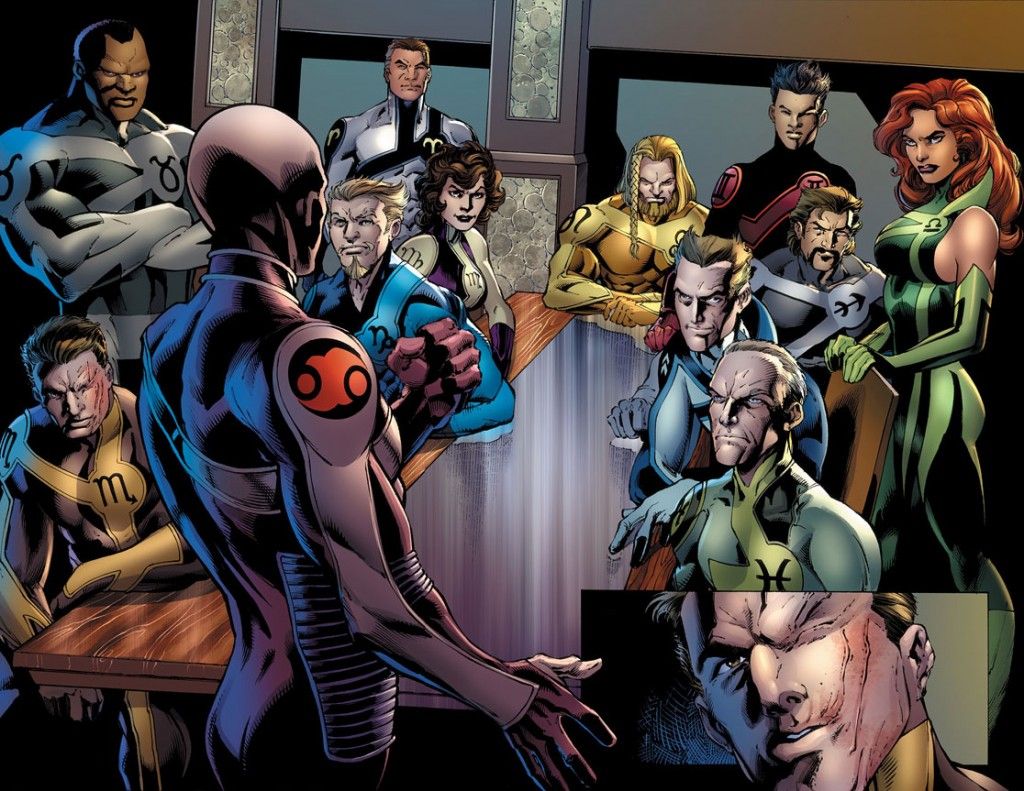
Our team consisted of Thor, Bruce Banner (Hulk), the Thing, Moon Knight, Wonder Man, and myself as Wolverine. Apparently, our team had been travelling around the world collecting cosmic artifacts like the Cosmic Cube, the Ultimate Nullifier, and other such paraphernalia you likely have sitting around your basement. We have been hounded by Zodiac, which is a team of twelve recently cosmically imbued former henchmen that are all modeled after the twelve signs of the Zodiac.


So, our assembled Avengers team is hanging out on the SHIELD helicarrier. Thor has a keg of ale that he's drinking from, which Logan is sharing. Then, out of nowhere, a huge hole is blown in the side of the Helicarrier and we are attacked by the entire group of the Zodiac. Wonder Man tried to negotiate using his star power, which didn't go so hot. Banner tried too, but the return insults made him so mad he Hulked out. The rest of us more martial powers went to town, gutting, slicing, and punching whoever got in our way. Moon Knight was kinda doing he solo thing, hanging out in the shadows and hitting stuff with moon-based weaponry.

Needless to say, with such a large group, a blow-by-blow account would be difficult to map out, however, I can show off the highlights. The Hulk resisted an attack by roaring and slamming the ground to scare those assaulting him. Thor threw a guy who had burned out and took out most of the opposing team while saying something about Asgardian kittens. And, y'know, Wolverine gutted and sliced people, which is always cool, since I was playing him. And stuff.

Once the Zodiac was defeated, Thor and Wolverine went back to drinking, until Thanos crashed into the Helicarrier, demanding the Cosmic stuff. When we said no, he did a cosmic attack that knocked out everyone, except Thor, who was invulnerable, the Thing, who left for a date before Thanos arrived, and Moon Knight, who escaped via the Moon Copter. Thor and Thanos had a pretty epic duel, involving a lot of grappling and throwing around cosmic might before Maria Hill activated the self destruction sequence on her ship and blew it all sky-high.


My Reaction:

First of all, I have to say, it was great seeing and playing with these guys again. They're a great bunch, and the new guys that I haven't met before were also cool. Everyone did a great job staying to character and there was a lot of creativity going on.

The Doom Pool got pretty huge this session, which makes sense, considering there were six players and a mob consisting of twelve d10, which is pretty insane in of itself. However, it made a lot more sense than stating out each individual villain, and made things run much more smoothly. Well, smooth enough. Thanos was likewise very powerful, and backed by the mighty Doom Pool, he was virtually unstoppable, which makes sense, since in this comic, the Guardians of the Galaxy popped in to help at this particular point.

Other than that, I wasn't expecting much since this was a stress test, and had a good time! Looking forward to next Monday when Civil War proper will begin.

Hope you enjoyed my post about this stress test! If not, here's a funny picture.

-Wes


Friday, May 24, 2013

Teen Titans Modern: Milestones and Unlockables

Hello, readers!

As an addendum to the previous post, I thought it would be interesting to share a few of the Marvel Heroic specific things I've developed for this campaign.

For many people, milestones and unlockables are the trickiest part of running this particular system if you are not going through an already published adventure. This is understandable, since this bit is all at once one of the best and worst things about the system. The idea of milestones is an amazing storytelling incentive, a way for the player to tell the GM how he wants his character to grow and focus on through the story, and it encourages character-based roleplaying, which I absolutely adore. However, I've never been a fan of experience points (I don't use them at all, usually) and with a system that encourages you to build a character  at or near their peak, using XP for advancement usually seems wrong, which gives the incentive to develop unlockables. Only problem with that is, unlockables are a tricky beast to develop, and there aren't a whole ton of examples to work off from.

Milestones are also tricky to develop sometimes, but there are more than enough examples throughout all of the books that you get the pattern and feel for them relatively quickly.

That being said, here are my unlockables and milestones for this event so far. I'm always adding more... At least as far as milestones are concerned. Feel free to steal, edit, etc. Some aren't perfect, but they've been working quite well so far.

(My favorites are Bane of the Future, LexCorp Conspirator and Titans Go!)

Teen Titans Modern Milestones:


World's Greatest Assassin? -

1 XP When: You confront the world's greatest assassin, Deathstroke.

3 XP When: You best Deathstroke in one-on-one combat.

10 XP When: You join the League of Assassins to usurp Deathstroke's famous legacy, or dedicate your life to shutting down the League.

Joke's on You -

1 XP When: You take emotional stress from the Joker or Harley Quinn.

3 XP When: You deal emotional trauma to the Joker or Harley Quinn.

10 XP When: You kill the Joker in a disturbingly amusing or ironic fashion, taking a step towards continuing his legacy, or you effectively stop one of the Joker's most devastating gags or jokes.

Blood War -

1 XP When: You witness a ritual of the Cult of Blood or see evidence of one that has occurred.

3 XP When: You break up, disrupt, or prevent a meeting or gathering of the Cult of Blood.

10 XP When: You form a temporary alliance with the Cult of Blood to learn more of their power and get rid of Deathstroke, or you wage a personal crusade against the Cult.

A Raven in the Flock -

1 XP When: You reach out to the mysterious outcast, Raven.

3 XP When: You confess a secret to Raven, or she confesses one to you.

10 XP When: You save Raven's life from extreme danger, or she does the same for you.

We're Not Gonna Take It

1 XP When: You have a confrontation with VATOR forces.

3 XP When: You successfully destroy a VATOR taskforce or evade capture.

10 XP When: You avoid VATOR capture forever by illegally getting onto the coveted “Override” list, or you become a figurehead in the movement against VATOR.

Bane of the Future

1 XP When: You discuss technology's effect on society.

3 XP When: You defeat a tech-based villain and use his actions as an example of how technology is harmful, or you defeat a non-tech based villain using modern technology to show how it can be used for good.

10 XP When: You take up the Neo-Luddite cause and join Bane's crusade, or you confront and defeat Bane using your own philosophy on technology.

Lex Corp Conspirator

1 XP When: You make a connection between current events, Lex Luthor, and Lex Corp.

3 XP When: You discover concrete evidence linking Lex Luthor and his company to an immediate situation and follow-up on it.

10 XP When: You confront Lex Luthor with your conspiratorial evidence and show his hand to the authorities, or you agree to keep silent and give up the evidence to Lex Corp. in order to obtain something.

Titans, Go!

1 XP When: You take charge of a situation and give orders to your fellow teammates.

3 XP When: You settle an inner-team dispute, coordinate a training session, or push the team towards a common goal.

10 XP When: You are officially recognized by your teammates as team leader during a monumental situation, or you decide to give leadership to a better qualified team-member at a critical moment.

Cleaning the Streets

1 XP When: You take action against one of the various city gangs or the mob.

3 XP When: Your actions are able to topple the power of a reigning gang or arrests an influential mob leader.

10 XP When: You're hailed as a hero by crippling gang activity and decimating the Mobs influence in Detroit, or you end your crusade against organized crime and gang violence to save yourself from the retribution to come.

Super Celebrity

1 XP When: You are thanked by a citizen for a specific heroic deed, or asked for an interview by a reporter regarding your current super-heroics.

3 XP When: Your fame creates trouble, causes a situation to get worse, or distracts you from doing your duty.

10 XP When: You use your fame to solve an impossible situation or generate support and adoration for superheroes everywhere, or you give up the superhero lifestyle out of guilt or in order for someone else to be saved.

Good Student

1 XP When: You relate something you've learned in school to a current situation.

3 XP When: You choose to study instead of participating in an important event related to your superhero career.

10 XP When: You use something you've learned to defeat a major villain at a critical point, or you flunk out of High School in order to further pursue your superheroics.

Mentor

1 XP When: You approach a significant member of the superhero community for help or advice.

3 XP When: You work closely with your chosen mentor to overcome a significant obstacle.

10 XP When: You choose to partner up with your chosen mentor in a more permanent fashion, becoming an heir to their legacy, or you dismiss the teachings of your mentor and abandon them completely.

Love and Spandex

1 XP When: You flirt with another member of the superhero community.

3 XP When: When you begin a relationship with another hero during a stressful event.

10 XP When: Your love is an important factor in overcoming an impossible situation, or you break up in order to better focus on the task at hand.

Teen Titans Modern Unlockables:


[Green Arrow's Arsenal] 5/10 XP: For 5 XP, you can unlock the use of the Green Arrow Arsenal power-set. However, if it is ever lost, stolen, or broken, only Oliver Queen can repair it. Spend 10 XP to learn how to repair it yourself, gaining it as a normal powerset.

Green Arrow's Arsenal:

Enhanced Durability d8
Weapon d8

SFX:

Shoot to Kill: Add a d6 to your dice pool for an attack action and step back highest die in pool by -1. Step up physical stress by +1.

EMP Arrow: Target multiple robot or computerized opponents. For every additional target, add d6 to your pool and keep +1 effect die.

Armor Piercing Arrow: Step up physical stress you inflict by +1 when your target uses a Durability power in their reaction pool.

Tear Gas Arrow: Target multiple opponents. For every additional target, add d6 to your pool and keep +1 effect die.

Explosive Arrow: Step up or double Weapon for one action. If the action fails, add a die to doom pool equal to the normal rating of your power die.

Limit:

Gear: Shutdown Green Arrow Arsenal and gain 1 PP. Take an action vs. doom pool to recover.

[Police Support] 5/10 XP: For 5 XP, you can unlock some support within the local police department. When you spend 5 XP, you are able to create resources at a Master level for the following disciplines: Crime, Vehicle, Covert. For 10 XP, you can call in the police to assist you for an action scene, gaining a squad of cops to fight at your side.

[Super Hero Club] 5/10 XP: For 5 XP, you start a Super-Hero club at the local High School, which attracts the attention of some local teenage heroes who are "still in the closet," so to speak. You can call upon them for support in one action scene. For 10 XP, you can unlock one of your choice as either a playable character or an NPC'd permanent team-member.

[The "T" Car] 10 XP: For 10 XP, you can have Green Arrow whip you up a souped up and incredibly advanced vehicle for your team.

The "T" Car:

Durability d10
Speed d10
Gun Turret d8
Cybernetic Senses d8

SFX:

Oil Slick: Spend 1 PP to introduce the Slick Streets scene distinction to the action scene.

Turbo: Step up or double Speed (spend 1 PP to do both). Stepdown Speed -1.

Room for Everybody!: Spend 1 PP to remove you and one other character from the Scene. Other characters may tag along for 1 PP from each of them.

Limit:

Just a Car: When the player takes d12+ physical stress while driving the "T" Car, step down physical stress to d8 and Shutdown The "T" Car powerset.Bring the hulking mess back to Oliver Queen during a recovery scene to get it back.

Mutually Exclusive: Shutdown your current powerset to activate The “T” Car. Shutdown The “T” Car to recover your powerset.

[Connections with the Big Leagues] 5/10 XP: For 5 XP, you can call into the scene one of the big-name Superheroes that you are allied with who will offer support for the remainder of the scene. For 10 XP, you can call them in to take out one villain, then leave.

[Heroic/Dangerous Superhero] 5/10 XP: For 5 XP, you can earn the reputation in the city and the world for either being a noble hero in the eyes of citizens, or one that is dangerous and destructive. This will grant a fourth distinction that can be used until the end of the Act. For 10 XP, this distinction lasts until the end of the Event. Some examples of distinctions include: “One of the Good Ones” “Public Liability.”

[Hacked into VATOR] 5/10 XP: For 5 XP, you or a close ally has broken into the VATOR network, able to track communications and look up database entries. You can create a Master resource in preparation for a future encounter. For 10 XP, you can call in VATOR forces once to end a scene in your favor.


And, there you go! Hope you enjoyed this look at milestones and unlockables. If you didn't, here's a funny picture.

-Wes


Thursday, May 23, 2013

Teen Titans Modern: The TV Show Format in Action

Hey, readers!

Piggybacking on my last post, I thought that it would be nice to explain in a little more detail the nitty gritty details of how you would implement the TV show model in preparing for a campaign. Rather than go through a long, step-by-step tutorial in which I go into too much detail, I'm actually going to show you my notes for the campaign set-up and explain them.

As with everything, this is just the way I did it. By no means is it the only way, or the right way, or a good way. It's just the way that worked for me. I'm typically a notes-light GM, usually foregoing notes altogether and just letting things pour out based off a loose framework in my noggin. So, that's your disclaimer.

Anyway, let's get to it, shall we?


The Basic Framework:

Teen Titans Modern

Tentative Season 1:

24 Episodes:

End Goal for Team: Grow together as a team. Become friends and one fighting unit. Make a decision whether or not to live the superhero lifestyle.

Main Arc: Deathstroke, under the order of Ra's al Ghul, begins a war against the Cult of Blood in Detroit.

Secondary Arc: The Joker and Harley Quinn try to profit from the ensuing chaos, starting a gang of misguided teenagers and playing both sides against each other.

Tertiary Arc: The government has declared war on the Superhero community, apprehending both heroes and villains in order to get them to register to be a government agent, or kill them.

Commentary: What I did first was set a groundwork number of episodes that I wanted to shoot for. This could change, of course, but I determined that you could either go half season (12 episodes or so) to a full season (22 episodes or so). Since Marvel Heroic broke things into acts, I went with a nice even 24 that I could split into three acts with eight episodes each.

The next thing I did was set some goals that I wanted the team to accomplish over the course of the season. If we get to the end and all of those things are true, I know I did my job. Each character has their own goals, but those are listed elsewhere.

Next, I set up the A-story, B-story, and C-story for the season, the basic arc that the campaign will travel through. While these elements are all set up, not all of them will come into play immediately, or even come into play every session, but every episode works to either build on these arcs or work on the goals.

Main Villains: Brother Blood, Deathstroke

Secondary Villains: The Joker, Harley Quinn, The Government

Tertiary Villains: Bane, Riddler, Lex Luthor, Murmur and Onomatopoeia, Suicide Squad, Professor Ivo and Amazo

Main Supporting Cast: Green Arrow (Oliver Queen), Black Canary (Dinah Lance), Firebird (Bette Kane)

Secondary Supporting Cast: , Starfire (“Tori Anders”), Beast Boy (Garfield Logan), Terry Sloane, Raven

Tertiary Supporting Cast: Batman (Bruce Wayne)

Setting:


Detroit, Michigan

Commentary: What I did here was lay out the basic set-up for NPCs that will be involved in the arcs and the story. This list is here so that I can stat them out, if need be, or so I have a good visual of villains I want to use or potential allies ordered by importance. By ordering them like this, I know which villains and allies I need to emphasize and really flesh out, and which ones don't really need all that much emphasis. I also put the basic setting down here, though that could obviously be expanded.

The Episode List:

Act 1:

Episode 1:
“Lockdown”
Main Villain: The Government, Suicide Squad
Main Plot: The first meeting of the Titan Initiative is disrupted by an attack by the government's new taskforce, “Vigilante Arrest and Termination Organized Response” 'VATOR'

Episode 2:
“Blood”
Main Villain: Blood Cult, Brother Blood, Deathstroke
Main Plot: The team begins investigating a budding gang-war that seems to be funded by powers unknown with the only clue being the blood scrawled message, "Where is Brother Blood?" Meanwhile, Juan has to work on a school project with a very unusual partner.

Episode 3:
“Laughter”
Main Villain: Joker, Harley Quinn
Main Plot: When the Joker publicly challenges the Dark Knight by causing chaos in the Detroit area, the Titans are the first response. Are the Joker's crimes carrying a deeper message? And how does Dullahan's past factor in with the laughing mad-man and his crew?

Episode 4:
“Stars”
Main Villain: Dr. Light
Main Plot: It's Christmas time in Detroit! The Titans deck the halls of the mansion for the upcoming holiday when Johnny realizes he hasn't gotten anything for his new girlfriend. A trip to the mall turns terrible as Dr. Light attacks, amplified by the festive lighting for the season. Johnny's blow to the head sends him on a rather detailed trip through a familiar Christmas favorite.

Episode 5:
“Conspiracy”
Main Villain: The Government
Main Plot: VATOR forces return to the streets of Detroit, taking a more subtle approach. Suspicions arise as their actions seem to follow Green Arrow's own plans for cleaning the streets. How exactly did Oliver Queen clear his own name and get the government out of his city in the first place?

Episode 6:
“Survival”
Main Villain: Professor Ivo, Solomon Grundy
Main Plot: A group of teen heroes are kidnapped by the mysterious Professor Ivo and set on an island. Infected with a disease that is working through their system, they must journey across the wild jungle in order to find the antidote, but they are not alone...

Episode 7:
“Override”
Main Villain: The Riddler
Main Plot: The entire Detroit underworld competes in the Riddler's insane games for a chance at getting on the fabled “Override” list that promises VATOR immunity. Will the Titans play along to apprehend criminals, or go for the illegal prize themselves?

Episode 8:
“Shutdown”
Main Villain: Bane
Main Plot: After an encounter with a group of fanatical Neo-Luddites testing an EMP, Ray Kord finds that he can no longer transform into the Blue Beetle.

Episode 9:
“Blackout”
Main Villain: Bane, Deathstroke, Brother Blood
Main Plot: ?

Commentary: Here we see the first act already listed out. What I obviously did here was give every episode its own name, determined which villains were involved, and did a basic plot summary. Some plot summaries have an A and B plot, some do not, depending on the needs of the story. I listed these out before the game even began using some of the information above. However, there were changes that I needed to make based on player desires, such as a Christmas episode, and an episode where the team was trapped on an island with Solomon Grundy which stretched the first act to nine episodes instead of eight.

What I try to do here is make some episodes spotlight characters. For example, Episode 4 is centered around Johnny while Episode 8 has to do more with Ray. This way, the players get their own episode to shine, define who they are, and grow.

Just for some particulars on how this relates to the framework, I have decided that the first act will mostly deal with the tertiary plot arc while laying seeds for the main and secondary arcs that will explode into fruition in the final episode of the act. We are currently on episode 7, having taken a long hiatus as Dullahon's player went to England for a semester and we had trouble coordinating times with her. Hopefully in June we will begin again and finish out the season by the end of the summer.


And that's all I gotta say about that! If you guys want more details on how these episodes went down, let me know! I also have milestones I can share and no shortage of datafiles. Hope you enjoyed this look into the TV Show format in action. If you didn't, here's a funny picture.

-Wes


Tuesday, May 21, 2013

A Game for a Season: Running a Campaign Like a TV Show

Hey, readers!

Today, I'm going to share a campaign layout that has changed the way I think about running games in general. To be honest, I'm not 100% if someone else has thought of this before or laid it out the way I have. Personally, this is from my own brain and not ripped off from someone else's ideas. (At least not intentionally.)

With that out of the way, let's address a common assumption.

Most people think of role-playing campaigns in one of these two mediums: books and movies. And why not? For a long time, books and word of mouth were the main ways that stories were communicated. Film is also a huge contender these days as a viable visual medium that tells about the lives of people, the terrible things that happen to them, and how they try to resolve it.

What do these two mediums have in common?

First of all, most books and movies follow the basic plot mountain scheme. Remember this from High School?


They both tell one story about a character or group of characters that follow this main arc. We meet the people involved, something happens that set larger things into motion and creates a problem, the characters try to solve the problem and get into more situations until it all explodes in one climatic scene, then the issue is either resolved or unresolved, someone or something has changed, and it ends. There can be sub-plots, but that's the basic stretch of the narrative.

You also get this story told to you over a reasonable amount of time. For movies, that ranges from an hour and a half to about three hours typically. For books, that really depends on the length of the book and how fast you can read, but unless you are an incredibly slow reader or the book is a tome, it won't take you more than a few weeks at most to finish.

However, if you try to place this model on an extended roleplaying campaign, it starts to break down in some rather distracting ways.


First, most roleplaying campaign plots don't fit neatly on plot mountain there. Sometimes the exposition is muddy or thrown out completely. 95% percent or more of the time spent in the game is dealing with the rising action while the climax, falling action, and resolution are usually resolved in one session. Not to mention the tendency of a lot of games, especially when D&D is involved, to just go from town to town or dungeon to dungeon with a loose narrative tying it together to make it somewhat cohesive, which makes the plot a series of hills rather than Mt. Everest.

Not to mention, there are sections on the 'Rising Action' slope that are boring and tedious which can consume entire sessions, making certain characters feel left out or abandoning an element someone enjoys completely. Dungeon crawls, anyone?

Secondly, roleplaying campaigns are not completed in a timely matter whatsoever. Most groups, if they're lucky, meet once a week, every two weeks, or once a month with a session that typically lasts anywhere from two to three hours or more. If you're going from start to finish, it could take a year or more to finish a campaign. Most games don't even survive that long! People move away, get new job schedules, can't make it on gaming day anymore, or the campaign just fizzles because you're stuck on the Rising Action slope. How many campaigns are actually finished, or even reach the climax, which is supposed to be the best part?

Not many.


So, maybe there needs to be a new model. What sort of entertainment offers a story about characters going through problems in reasonable time chunks where plots are more like a series of hills in a mountain range offered over an extended period of time?

TV shows.


If we model our campaigns and sessions after TV shows rather than movies or books, we open up a more satisfying and compatible system to work off. Just think about your favorite TV show for a second or two. What elements are in play here?

-A somewhat stable cast of protagonists and antagonists that appear every time.

-Episodes that have a beginning, middle, and end, usually with a climax included.

-Episodes that don't last more than 12 minutes to an hour.

-Sometimes they include an overarching story and meaningful changes based on events that happen (Continuity). Sometimes they don't.

-Groups of episodes are divided into seasons that typically have anywhere from 12 to 22 episodes.

Now, let's translate those episodes into role-playing campaign philosophies. 

-The cast consists of the player characters and any important recurring NPCs.

-Every session deals with a unique issue that is resolved by the time the session is over, with a climax included!

-Plot mountains can be completed within the span of a session with a smaller scope.

-Sessions have the opportunity to build off of one another and create an overarching plot that is advanced in some way by the smaller plot mountains that the season consists of. However, if you do not want to stick to continuity too much, depending on your style of game, you don't have to! 

-You can end the season whenever you want! You are not necessarily waiting for the huge payoff that the climax gives, so you can wrap up loose ends, shut the game down, and renew for another season if you want to return to those characters/stories again!

I'll go into more details in the nitty gritty by showing you how I've done this for my Teen Titans game in the future, but for now, these are just some things to wrap your mind around. I will say that this system and model will not work for every group template or group in general, but for some of them, it is so much easier on the GM and more satisfying for the players.

Hope you enjoyed my long post! If not, here's a funny picture.

-Wes


Friday, May 17, 2013

What I'm Running Right Now

Hey there, readers!

So, if you read my last post, you would know that I have a bad case of Perma-GM syndrome with all of the real-life groups I've created in the past five years or so. It's not a huge problem, as long as I have some sort of outlet for my playing desires every couple of months or so.

Besides, I'm a much better GM than I am a player! At least, I think so.

Unfortunately, due to my current life situation, I'm not running much, but that is due to change! In this post, I will be explaining what I'm running currently, and what the immediate plans are for the summer. Expect play reports in the future from these things!

What I'm Running Now:

Teen Titans Modern


I have a confession.

Ahem.

There are a lot of things about the DC Universe that I think are stupid.

There are also a lot of things I like, but the stuff that irks me almost spoils the bunch. Almost.

Therefore, I've taken it as a personal project to reinvent the DC Universe to a point where it is tolerable to me. Throughout this process, I've changed the origins of many heroes, entire histories, swapped around powers, sources, toyed with iconic images and made them unique. It's one of my many pet projects, and one I'm rather proud of.

I call it DC Modern.

In order to explore one aspect that was mostly left underdeveloped, I decided to run a game in this universe centered around teenage heroes using Marvel Heroic. I gave my players the choice to create unique characters or adapt existing Titans to fit in the universe. Here's a short roster:

Blue Beetle II: The youngest team member. His father was the original Blue Beetle, and when he was killed by Deathstroke, the scarab armor bonded to young Ray Kord, transforming the awkward teen into a still awkward superhero.

(A professional artist's rendition of the player as the hero)

Dullahan: A mysterious teenager with a past he cannot even recall. James Ulysses (naming himself after the author of his favorite book) has a head composed of ethereal thought tentacles that can move things about, read minds and the histories of objects, and do some things we're not even sure of.

(The player is a very talented artist!)

Johnny Thunder: A deadbeat teenage runaway with the power of sound projection! While his abilities seem to be a mutation or the result of some sort of accident gone wrong, they are actually magical in nature. He also has an amazing vehicle, "The Fuckin' Car"

Schrodinger: Juan Cervantes was born with an unusual quirk. He is, constantly, everywhere in the universe at once, and with an expression of will, he can move his 'physical body' anywhere, or expose more of his physical bodies at any given time. From birth, he was trained to be an assassin by Lady Shiva, and has only recently left her care.

So, I'll likely be putting up 'Episode Summaries' since I run this game in a TV Show like fashion that I will elaborate on later, but that is the basic premise. A grittier, more urban Teen Titans set in my own DC Universe.

What I'll Be Running Soon:

The Barrier Gem Prophecy: Civil War

This will be a sequel to a fantasy campaign I ran for my college group a little more than a year ago. I won't go into too much detail here since there's still a lot of variables with this one, but the main premise will be an 'Early Fantasy Civil War Arms Race.' Doesn't that sound fun?

Edge of the Empire: Escape from Mos Shuttaa

My first group that I created in freshman year of High School is getting together again for a few months this summer, and since we've all been playing Star Wars rpgs for forever, we're going to give this one a try! I'm really digging this system so far, and I'm hoping that I don't muck up this cute little module too much when I run it next week.

Something Else?

A big part of me wants to return the favor to all of the wonderful people over Google+ (Who are likely my only audience at the moment! <3) who ran games for me in the past half a year or so. So far, since most of them have been using Marvel Heroic, my inkling is some sort of game using that.

An experiment I've wanted to do for a long time was to create a revamped version of the Marvel Universe, much like I did with DC, but in a different fashion. Basically, I would run an Origins game for a certain aspect of the Marvel Universe, like.. Fantastic Four Origins, or X-Men First Class, or something to that effect. Instead of me asking my players to build things up from something I've already established, the players would craft the universe with their characters, backstories, and what happens. It'd be, like, a mutual universe creating thing-a-mabob meets the Ultimate Marvel basic idea of retooling stuff.

If that sounds cool, let me know!

Anyway, that's what I'm running now and what I'm running in the future. Hope you enjoyed it! If not, here's a funny picture.

-Wes