Showing posts with label d&d. Show all posts

Thursday, June 13, 2013

Why 4th Edition Really Grinds My Gears

Hey, readers!

I'm not really sure why this topic came to my mind. I mean, it's not an original opinion or anything groundbreaking. Plenty of people don't like D&D 4th Edition for very astute reasons that have been carefully laid out and explored ever since it came into existence. In fact, I could likely link you to a variety of articles and videos telling you precisely why 4th Edition sucks.

But I won't.

'Cause I gotta throw my two cents in while 4th Edition is the current figurehead of the biggest role-playing game in existence.
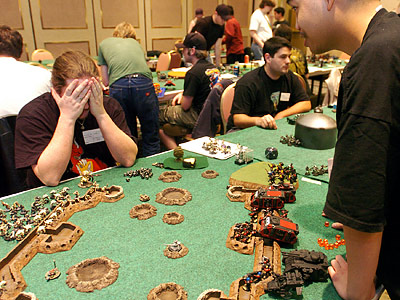


It's no surprise really that I don't like this system. Hell, I don't even like Dungeons and Dragons. Shocker, right? While I do enjoy fantasy to an extent, it is by no means my favorite genre, and D&D has always been too technical, grindy, and bloated with things that usually don't fit into my settings or don't interest me all that much. Still, it's what the masses want, so despite my better judgement and opinions, I have to run it and play it to either keep my friends happy or give non-gamers something they've heard of to break them into the hobby.

That being said, I will admit that 4th Edition isn't a horrible way to get non-gamers into the hobby. It's simple enough, identifiable, teaches the basics of the hobby, and you can have a good time with it. Believe me, I have. In those ways, it succeeds in being a game that can be played and enjoyed, so it's not complete and utter garbage.

Unless you have an inkling of design and role-playing game sensibilities. Then it's complete and utter garbage.

Let's break down the reasons, shall we?

Reason 1: The Three Tiers

God, is this stupid. So, the game tells you straight out how your character's career is going to go based on levels. 1-10 is the Heroic stage, where you do what is typically expected in a fantasy game. 11-20 is the Paragon stage where, after the passage of one level, you are a major player deciding the fate of the world or nation, flying on hippogriffs or teleporting, fighting bigger and deadlier monsters. 21 and on is the Epic tier, going across nations in an instant, fighting in the air, deciding the fate of the multiverse.

But, hold on. So, if I want a game completely based on heroes that are usually presented in something akin to Lord of the Rings, Mistborn, or other fantasy realms I like, I'm limited to level 10? If my players go beyond that, they are suddenly breaking into stuff that may not even be in my setting? Why are my players or myself constrained to this career path? Sure, you can ignore the fluff, but the game won't. And it will take a lot of editing to scale down some of the powers and abilities you can get down the line.


Thanks for assuming I'm going to be playing by your setting expectations, D&D. Don't label yourself as a fantasy system for all flavors if you're gonna pigeonhole me to the dungeon crawl, shake the nations with power template.

Reason 2: Skill Challenges

If you've been following this blog in any capacity, you know that my favorite part of RPG is the 'RP'. I'm usually not a big fan of the game part. I prefer role-playing, creating characters, getting into character, interacting, talking, going through a character arc, emotion, all that fuzzy stuff.

Here's a middle finger to all of that.

4th Edition introduced the idea of skill challenges, something I swiftly threw out, and the players I ran the game for probably forget that they exist. Basically, it's a complicated series of skill checks meant to represent some kind of encounter that isn't combat. So, the game designers sat down and said, "Okay, combat is all statted out to the last letter. Players might get bored if they're doing something not in a dungeon that has something to do with a thing called story, like convincing a king to go to war or exposing a liar, so we'll make it like a combat encounter! They'll roll a lot of dice and stuff! Can't have anything fun happening without the rolling of dice!"

So, an important role-playing encounter is now just another series of rolls, hardly influenced by the player's wit, charm, or ability to talk through situations. While this may help a player who is socially awkward play a suave diplomat because he's trained in diplomacy on his sheet, it cheapens an important part of the tabletop RP experience into something trivial and almost unnecessary. I could see an encounter like this go with just rolling dice with no explanation, and the whole thing is blanketed over and resolved in time to get to the next combat encounter.


Again, if you like that sort of thing, that's fine! Still, though, you are potentially cutting out a part of the game that is important to weird people like me who'd prefer to spend two hours sitting around a campfire and swapping stories than slay an army of orcs.

Reason 3: Classes and the 'Powers' System

I saved the best for last.

Picture that room of genius game designers again. "Alright, so, in our last edition of the game, people who played fighters and rangers and stuff were bored because all they did was hit things while the magic users got to pick spells and think. So, here's my idea, now everybody gets to choose things like spells!"

"What about the fighters and rogues who don't use magic?" asks someone who's paying attention.

"Ah, but they won't be called spells! They'll be called powers! Fighters can do special moves that attack stuff in neat ways and rogues will be all special sneak attack, flourish, and stuff!"

"So, what's the difference between a wizard's fireball spell that does a d8 of damage versus a fighter's special attack that does a d8 of damage?" asks the same guy who's paying attention.

"Uh, nothing, when you get right down to it."

"And aren't special moves and ways to improve normal combat what feats are for?" asks another person who just woke up.

"Screw feats!"

And there you have it, folks. Now, wizards and sorcerers are like everyone else. Their powers are pretty much equivalent to the special moves of their more mundane counterparts. No more studying up spells. They just go off, like magic! Sure, maybe this class can heal, or this class has a plus two to something that no one really cares about, but all of the classes are able to do cool things, all the time!

I think Syndrome said it best.

(Sorry for the bad quality~)

This becomes painfully obvious when you look at the way they handle multi-classing in this edition. Basically, you pick up the multi-class feat, pick another class, and you get one of their special things that no one cares about and an extra power. And that's it.

And, obviously, feats get the shaft too. No more careful optimizing, you power gamers who love this system so much! Feats give you little bonuses to things you don't care about, and there's a lot less of them of you're just working off the original three core books.

This is garbage on so many levels, it's not even funny. What was supposed to make combat more interesting and fun becomes mundane incredibly fast. Hell, there's not even a point with just attacking with your weapon anymore. Just do your At-Will, over, and over, and over.

Doesn't matter what class you pick. Scramble the ability scores a little, pick a race, grab a class out of the bag and you're set to go. Oh, but aren't there RP implications of being a wizard versus a fighter? Nah, D&D doesn't care anymore. That's why they added Skill Challenges. So, go ahead, whether you're shooting magic missile or stabbing a dude in the back, roll those pretty little dice, do some damage, crawl a little further into the dungeon, advance down our preset career path carefully laid out for you. Have you tried our Neverwinter setting, perfectly optimized for that carefully laid out career path? Well, you should! 'Cause creativity is for losers.

Rant Over

God.

That felt good to get off my chest.

Anyway, whether you agree with me or not, I hope you enjoyed my slightly bothered ranting. If not, here's a funny picture.

-Wes

Tuesday, June 11, 2013

My Favorite NPC - Balthazar

Hey, readers!

So, I'm a part of an organization now called the Role-Playing Blog Alliance which is sort of a centralized hub for blogs about the hobby which gives you free advertising and stuff. It's pretty cool. One of the things I noticed on there was something called a 'Blog Carnival' where a blog puts up a topic and everyone that wants to makes a post about that topic.

In the interest of ranting about random topics, as I thoroughly enjoy doing, I decided to throw my hat into the ring!

This month's topic is 'My Favorite NPC.' Now, as someone with near Perma-GM syndrome, this is kind of tricky, because I haven't really played in games long enough to find an NPC that I really, truly enjoyed interacting with. Not to say that there haven't been some great ones, but none that I would elevate to the status of 'My Favorite'.

Of course, I could just be a derp and maybe this topic also includes NPC's you've created and ran, but I digress.

I'm going to cheat a little.

The first D&D campaign that I ran in college was a real treat to run, and at some point I'll probably elaborate more on it, but there came a time where I really wanted to play. So, a friend of mine said that she wouldn't mind running the game for a while and we changed guard. The NPC I am going to describe first showed up during the segment where I was playing, but I decided to bring him back and make him an important part of the plot when I got back in the GM chair after my character's touching death via sacrifice.

Without further ado, let me introduce you all to...

Balthazar


Origin:

Balthazar's origin came at a time where a lot of my player's wanted a nemesis of some kind. My friend Harry, who was playing a Samurai, wanted to have an Oni that killed his mother involved in the plot somewhere, so I allowed that for a bit. Then, my friend Jean, who was playing a Revenant Assassin in service to the Raven Queen, wanted a nemesis of his own. I didn't get a lot of details other than a name, and that he was a former Assassin of the Raven Queen who left the order.

My friend Ellen took the game over for a bit while her character was trapped in a pocket dimension. Fun, right? Well, anyway, she first introduced the character as someone who was working with a mysterious figure known as 'The Occultist' who worked for the bad guys. He didn't have a lot of depth, just a bad-ass Eladrin assassin leading a twisted family of monstrous freaks. We didn't see too much of him.

When I got the reins back, I decided that Jean's nemesis didn't get enough screen time, so the wheels in my head started to turn, and I planted him at a most inopportune moment as a sort of off-the-cuff, unplanned way to prevent my party from doing something nearly suicidal. They were about to go kill a dragon on top of a mountain, who had a macguffin and was also the creator of the Dragonborn in my world. Only one problem, though. If a Dragonborn is hit by this dragon's fire, they turn into ash instantly, since that was the fire that created them. We had two Dragonborn in the party, too, so this was potentially going to be a disaster.

So, there to warn them about the dragon's fire and tell them that there's a way to make the fight much easier was Balthazar. Now, I'm an impressionist, so I enjoy doing cool, strange voices for my NPCs/characters. Somehow or other, by fate or chance, the more I talked as Balthazar, the more he started to sound like a certain celebrity. Not a particularly famous celebrity, mind you, but one that is close to my heart.

John de Lancie.

(I actually met him and shook his hand!!)

And, thus, Balthazar was born.

Appearance:

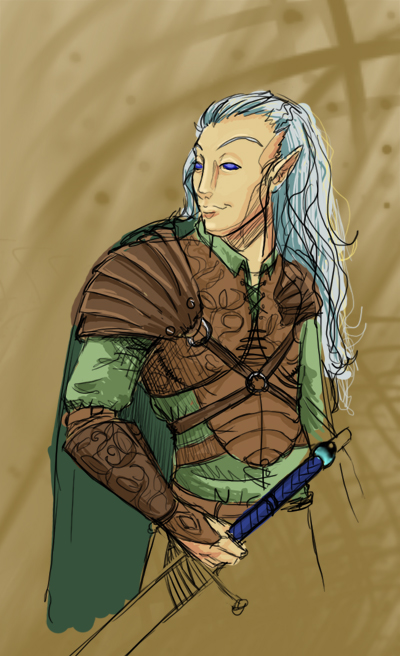
So, Balthazar is an Eladrin in a world where most of the Eladrin were corrupted into Orcs for messing with the Gods and the ones that remained had some weird sort of destiny. As such, he looks like an elf pretty much, tall and lanky with the pointed ears. Except, I picture him as a little taller and lankier than most, almost skeletal in his appearance but he tries to hide that with his clothing and mannerisms. Long silvery hair cascades down his features, very fine with an almost glittering quality to it. Since Eladrin are practically immortal, or else incredibly long lived, he still has a youthful face, but his piercing blue eyes carry the weight of a thousand years.

Personality:

This is where Balthazar becomes fun. Since the voice started to sound like John de Lancie, I decided to go full-out impressionist and mimic his voice, which lends itself obviously to the 'Q'-like mannerisms. In almost an instant, this originally rather flat NPC became someone the party loved to hate. He always had a snide comment, a taunting air of superiority with a twinge of boredom because, after living so long, he has experienced almost everything. Balthazar is a man looking for his destiny that was apparently promised to him by the Gods, and his search has brought him into almost every profession and walk of life to no avail. He possesses an Ecclestiastian mentality that everything is meaningless in the view of mortality and death, and there is nothing he loves more than tearing down the hopes and beliefs of those around him, playing Devil's Advocate to every position because he knows better. In fact one of his most memorable quotes was the following:

"I love destroying religion. That's why I pick on the little one." - Balthazar, in regards to a young cleric in the party.

Oh, and he's kinda flamboyant, but that goes with the voice.

Why He's My Favorite:

In all of my years of GM'ing, I have never had an NPC that engaged the party to the level that Balthazar has. Come to think of it, in all my years of acting, this is the character that I'm most comfortable improving, and almost everything he said was gold. For this reason, the players kept him around in the party because he always had a secret, always had something to say, and kept the advantage as long as he could. We would have conversations that lasted for a half hour, debating things, talking about the past, the future, all of it a duel of wits which Balthazar almost always won. All off the cuff.

Come to find out, he's also the son of the main bad-guy, and that father and son team had enough persuasive power and were in such an opportune position that almost half the party joined their cult in order to get the last macguffin. Yeah, that's right. This NPC was so powerful by personality and presence alone that he could get half the party to join the cult that was hounding them the entire campaign.

Of course, he betrayed the party when the time was right, but that backfired. His father was killed, and he was left for dead in this huge pool at the bottom of an ancient, extra-dimensional plumbing system that was designed to feed blood to a vampiric dragon.


Yeah, you wish your campaign was that awesome.

And, even after all he had done, all of the snide comments and backstabbing and arrogance, they let him live.  For a party whose strategy was kill everything in sight, this is pretty significant.

These are the reasons why Balthazar is my favorite NPC ever. Yes, I ran him and played him, but it wasn't the cool factor or even my contributions that made him the best. It was the level that he affected the party, changed the way they viewed the story and the game. He made the game awesome, and you can't deny that kind of power that I have yet to see recreated.

That's my story! Hope you enjoyed it. If not, here's a funny picture.

-Wes

Sunday, June 9, 2013

Dungeon: A D&D Stageplay

Hey, readers!

I was brainstorming some topics to cover in the tabletop RPG realm for this blog when I was swiftly reminded of a project I undertook in college. As you may or may not be able to tell, I like to consider myself  a pretty creative person. My two major fields of creativity are through writing and acting, two things I've kept up with ever since I was a child. What's rather cool is that they can be combined in the art of play-writing, which is an art-form I absolutely adore.

My first play was a musical based off of Green Day's "21st Century Breakdown" album that was aimed to discover the narrative of the rock opera and create something that was a little deeper and more satisfying than the musical created for "American Idiot." Those that read it really rather enjoyed it, though looking at it now, there's not much I can do with it and the dialogue is in sore need of updating and revising.


Anyway, back to role-playing, I actually wrote a play in college based around a group playing Dungeons and Dragons. It is one of the most personal things I have ever written, projecting some of my ideas about the stereotypes and opinions about the hobby and injecting a lot of my own experiences into little nuanced bits and pieces. Every character is a splinter of me in some way, shape or form, some taken to extremes, some explored at a different angle, some completely reversed. It's basically a love letter from me to the hobby, dripping with the blood of my soul.

Graphic, right?

For those of you who would like to read it and tell me what you think, I'll put a link on this post to a place where you can look it over. I'm not really doing this to be self-promoting, nor am I really looking for any hard criticism. I just want to share a labor of love that may even ring a few bells in your own role-playing experience or make you think about certain things a little more.

Click me to read "Dungeon"

If you don't want to go through the process of reading through a college-level, fifty-odd paged play, I will put up some notes from my outline here for your perusal and hopefully you can glean some of the guts of the play from that.


"Dungeon" Outline:

Thesis: Dungeons and Dragons is a game of masks. Everyone gets one. By wearing them, one can see into a world of fantasy composed entirely of the thoughts, desires, and dreams of those playing. When the masks are taken away and reality seeps back in, those involved are forced to ask the question: “Which world is the dungeon?”

World: The world that explores this thesis is the basement of a teenage boy. Though never shown, it is smack-dab in the middle of a seemingly exemplary suburbia. Outside of this space, the world appears to be perfect, and have perfect inhabitants. Beyond appearances, it is actually the opposite, a land where one is not able to be themselves fully, a place that needs escape. In this basement, that world is broken temporarily, allowing another world to be witnessed, inhabited by the ghosts of “What I Want to Be” or “Who I Really Am” or “Where I Want to Be.” These ghosts cannot exist or move without characters from the first world giving them life, and die immediately when they leave.

Inhabitants:

(AN: Keep in mind this is all artistic metaphor and stuff.) 

Issac Silverman – In the outside world, Issac Silverman is a puppy held on a tight leash. However, this puppy isn't energetic, yippy, free. He's held tightly by his collar, and has been for far too many years, never allowing the puppy to become a man. When he enters the space of the play, he's let off of the collar and seeks to be the master of those he finds, but must constantly wrestle with the call of his own master and the fact that he isn't fully grown, despite pretending he is.

Josh Williams – In the outside world, Josh is a golden statue on a high pedestal. His pose constantly changes, depicting a star athlete, a great student, the perfect boyfriend. There are many who admire this statue, watching him closely, almost too closely. Some search for a stain, others try to make sure that he remains unblemished. When he enters the space of the play, he steps off of the pedestal, sheds the golden skin, and is allowed to breathe and live. However, he brings one of his onlookers with him, who is forcing him to wear that golden skin in a place of escape.

Francis Jones – In the outside world, Francis is a boy. His hair is short. His clothes are masculine. He has a penis. He likes girls. He likes sports. He likes blood, guts, dirt. The world has told him that he is a man. The world has shown him what a man is supposed to be, and he has obeyed. When he enters the space of the play, Francis is a woman. She has cast off everything that the world has told her to be, and has become what she's always wanted to be. She has a vagina. She likes boys. However, she is constantly reminded that the world, and the audience, sees her as a man, and defines her as such.

Kimberly Whisp – In the outside world, Kimberly is a ghost. People seem to see her, sometimes, but she's almost always faded from view. She doesn't walk like people do; she floats along with whatever occurs in the space around her. Sometimes she's heard, but always she squeaks. Squeaking is how ghosts speak in the outside world. It is all that's expected from them. Though they are alive, they are images of the people that died sometime in their youth, but yet live. In the space of the play, Kimberly is alive and ready to embrace all of the beauty of living, of freeing the girl that died years before. However, everyone in the outside world still sees her as a ghost, and treats her as such.

Mrs. Silverman – Mrs. Silverman is not allowed to enter the space of the play. Rather, she is a constant dwelling force in the outside world that is a reminder that the space of the play is a separate place. Once upon a time, Mrs. Silverman was a puppy on a leash, but that puppy eventually became a dog on a leash, and had puppies of her own. She doesn't know any different, and never got to experience any world beside the one outside. Therefore, she tries to control and drag back any who have tried to break the boundary. She is Cerberus.

Jade – In the outside world, Jade is a gem. She's green with jealousy of all of those that surround her, and therefore, must be adorned with all of the gold possible because she cannot recognize that she is a gem on her own. Only by looking into a reflection of gold can she see herself as a gem. Therefore, she has attached herself to the golden statue. She is a visitor to the space of the play and is able to see the strange ghosts that inhabit that place, but she is overly concerned with looking back into the outside world and into that golden reflection to see the gem. She is Lot's Wife and Job's Wife combined.

Brock – In the outside world, Brock is an infection. He is able to spread to whatever type of victim he desires, through words, through looks, through violence, through manipulation. Once the infection hits, it starts to consume, taking everything for itself, multiplying, and living through the bodies of others. Eventually, it leaves one body and jumps to another, leaving the victim beaten, bloodied, bruised, and irreparable. Unfortunately, this type of infection is incredibly attracted to ghosts. Brock enters the space of the play to take what is slowly being dragged away from him, evolving from an invisible virus to a behemoth. Brock is Bill Sikes.

Outline:

Act 1: Paradise

The first act will establish both worlds and those who inhabit each and walk the line between them. We will meet Issac Silverman, who is running a game of Dungeons and Dragons for his friends: Josh Williams, Francis Jones, and Kimberly Whisp. Josh brings Jade, his girlfriend, to the game, showing her what it is like. We will also meet the ghosts, the characters of the three players of the game, who represent “Who I Want to Be” for Kimberly, “Who I Really Am” for Francis, and “Where I Want to Be” for Josh.
Things proceed well, for a while, but the outside world keeps trying to seep in and interrupt. Eventually, Jade, a member of the outside world, breaks away due to disgust, followed by Josh, and the group takes a break from the game.

Act 2: Imprisonment or Freedom?

The second act will show how sinister the outside world can be, and the reaction of our characters to the confrontations presented. Issac will break his leash. Josh will melt down the statue. Francis will embrace his identity. Kimberly will solidify, and fight off the infection. Through this process of change, the outside world bears down evermore. The characters must then choose which world they want to inhabit for eternity after.


End of Outline Excerpt

I hope you guys enjoyed this look into a creative project that I'm really proud of. Let me know what you think if you read it! If you didn't enjoy any of this stuff, here's a funny picture.

-Wes