Well, the Civil War has begun, so to speak. The campaign, anyway, not any sort of national divide or something of that ilk. Our first session ran for almost four hours yesterday evening, and if you'd like to view it in its entirety, you can do so here.
(Hulk Smash!)
For those of you not in the know, I'll go over the cast list as is before delving into the summary and my reactions afterwards.
Oh, and... I may be doing in-character journal stuff too. 'Cause I like to write and I'm a nerd and stuff.
Iron Man and Thor played by Dylan. Daredevil and Hulk played by Christopher. The Thing and Yellowjacket played by Charles. Tigra played by Kathryn. Moon Knight played by Ryan. Spider-Man and Dr. Strange played by Bill. Captain America and Luke Cage played by Steve (Who was not at this session due to tech problems). Wolverine and Spider-Woman played by yours truly.
Session Summary:
It all began on a fateful day like no other!... Because, y'know, all the Avengers were just kind of sitting around the tower doing God-knows-what when Iron Man, who has taken up monitor duty, gets a call about Bill Foster, better known as the size-growing hero Goliath, walking down the street in a stupor and destroying things. Immediately, the Avengers spring into action!

What followed was an interesting collaboration of trying to get Goliath to settle down or beat the sense back into him. There was an amusing bit with Moon Knight literally standing on the shoulder of a giant and whispering to him about if he doesn't settle down, all of the cabbies in New York are going to be pissed at him. Then Goliath threw him at Spider-Man. Tigra slashed at his knees. Wolverine yelled and threatened stuff. Y'know, good stuff. Finally, Bill was knocked back into his senses when Tony faked out some sympathy and hit him with a fully armed uni-beam.
You know what's even worse than a drugged up Goliath?
The press and the media.
And, oh God, this is where the session got good.
Rather than relay what happened directly, let me pull some direct quotes from some post-game postings.
"Tonight from the Channel 4 News desk, are your underpants poisoning you? Then, exotic dancers caught in a dog-fighting sting! Later, we'll find out what Tigra's making for dinner and who the vigilante Moon Knight is dating."
Rumors abound that Moon Knight was spotted outside a Justin Bieber concert.
"Wall Crawling menace drives former hero into tragic rampage."
"Spider-Man steals antique book in Oklahoma."
"Wall Crawler admits to Bieber Fever."
"Spider-Man steals antique book in Oklahoma."
"Wall Crawler admits to Bieber Fever."
And my own personal touch:
So, after doing funny things to the press and telling them repeatedly to 'Fuck Off', we all move back to the Avengers Tower with Bill in tow to inspect him. Tigra goes on monitor duty and the brainy types, including Banner who just slid in, try to figure out what was up with Bill. They revive him and figure out that he was working with a company who was involved with Mutant Growth Hormone or something to that effect, and he blacked out. We get the location on a lab, just about the time we get a call that something landed in Broxton, Oklahoma and they need extra guard detail.
We tackle the lab and do a little changing of the guard. I swap out Wolvie for Spider-Woman under the logic that she was a private detective for a long time and would be good for an investigation (Yet she doesn't have the Crime speciality?). Daredevil is swapped out for Banner, and Thing is swapped out for Yellowjacket.

Spider-Woman starts this one off by sneaking in and getting a preliminary look at the place. What she finds is the illustrious members of the Serpent Society guarding the place, at which point she calls in the rest of the Avengers who crash through the skylight and begin slashing, truncheon-ing, moon-gadgeting, and finally, blasting what hadn't fallen by then with lasers. Unfortunately, Spidey and Yellowjacket didn't get their punches in before the Hulk smashed the lab to pieces and left for parts unknown.
Then began another highlight of the night as Moon Knight began a very brutal interrogation by slashing Diamondback's windpipe and threatening to do the same to Cobra. Iron Man took issue with this, and the two of them had a shouting match that caused Tony to leave the scene due to being mentally stressed out by the Avatar of Vengeance.
So, already we have some hero against hero plus bad news coverage. This is Civil War, alright.
Our final scene of the evening was playing guard duty over in Broxton, Oklahoma, which seems to be a dumping ground for anything Asgardian. Property there must be really cheap. Everyone went back to their characters from the beginning of the session, except for the fact that Thor stepped in instead of Iron Man for obvious reasons. There was some good banter on the jet and some back and forth with Maria Hill as we made our way over. Upon arriving, we were immediately shown what landed, which was a giant sword. The Twilight Sword, if my Marvel lore is as good as I remember it being, which is a herald of Ragnarok.
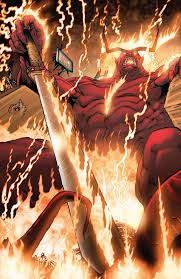
Isn't mystic mumbo jumbo fun?
Thor obviously wants to claim the sword and protect it from those who would use it for evil. Speaking of those people, Dr. Doom and his army of robotic minions arrives right on schedule! You'd think someone as smart as Doom would wait until the heroes had left, or attacked before they arrived? And wasn't the whole plot of the video game Marvel: Ultimate Alliance for Doom to get the Twilight Sword and steal Odin's power with it? Man, this would save him so much time and effort.
Anyhow, Thing goes straight for Doom, like he should. Thor, Tigra, and Wolverine have some fun smashing up the army of Doom Bots, which was as satisfying as it ought to be, really. Spider-Man stole the spellbook that Doom was using and taunted him to great effect. Moon Knight shouted at Doom a little. Oh, and Doom screwed up Daredevil's senses, but he managed to club the good Doctor over the head anyway. It was a pretty dramatic battle, lots of fun stuff going on, which finally ended with Wolverine gutting Doom... Only to find out her was a Doombot.

How many times can you use the word Doom in one paragraph?
We ended by Thor and Moon Knight trying to claim the Twilight Sword as their own by taming it, but neither succeeded.
My Reactions:
Overall, it was a good session. No question about that fact whatsoever. We had a lot of fun and memorable moments, and everyone seemed to be having a good time, laughing the night away at bad jokes and other such things.
For me, the highlights were two scenes in particular that really felt authentic and played beautifully. That would be the scene dealing with the press after Goliath was put down, and the battle with Dr. Doom. All of our characters really showed through when dealing with something almost everyone hates: the press and the media. Additionally, the Doom battle was satisfying even when there were about eight people involved.
The players are also a great bunch. Some are more soft-spoken then others, but I believe we really gel well and all contribute to the story in interesting ways. Our GM is clever and solid as I expected him to be, and he really seems to have fun running the game. Makes me long to GM again, really.
Still, the session wasn't perfect. Nothing's perfect, obviously. The start was a bit awkward, with no one really saying what their character was doing, myself included. I suppose it's part of being the first time we were all together (Except Steve) and the normal sort of hesitation and shyness that goes along with that. Even after that, there were a lot of moments of pause and a pretty jarring disconnect between some of the scenes, at least for me. The flow was off, but sometimes you can't help that.
Also, part of me thinks that Marvel Heroic isn't really designed for groups of this size. Just a personal gut feeling, considering the ease we went through some of our encounters. I mean, stress was pretty minimal across the board on our side, everything considered. I've even had trouble presenting a decent challenge to a group of four, much less a group twice that size. And, when you have eight heroes wailing on the bad guy, it's rather easy to see how the conflict could be taken care of before some people got a turn. In a game like this where action seems to take precedent overall, this can pose to be a real issue. It wasn't an issue for me, but the dice were on my side, and I got to go every round.
Those things aside, really looking forward to the next session!
Hope you enjoyed the recap! If not, here's a funny picture.
-Wes
Isn't mystic mumbo jumbo fun?
Thor obviously wants to claim the sword and protect it from those who would use it for evil. Speaking of those people, Dr. Doom and his army of robotic minions arrives right on schedule! You'd think someone as smart as Doom would wait until the heroes had left, or attacked before they arrived? And wasn't the whole plot of the video game Marvel: Ultimate Alliance for Doom to get the Twilight Sword and steal Odin's power with it? Man, this would save him so much time and effort.
Anyhow, Thing goes straight for Doom, like he should. Thor, Tigra, and Wolverine have some fun smashing up the army of Doom Bots, which was as satisfying as it ought to be, really. Spider-Man stole the spellbook that Doom was using and taunted him to great effect. Moon Knight shouted at Doom a little. Oh, and Doom screwed up Daredevil's senses, but he managed to club the good Doctor over the head anyway. It was a pretty dramatic battle, lots of fun stuff going on, which finally ended with Wolverine gutting Doom... Only to find out her was a Doombot.

How many times can you use the word Doom in one paragraph?
We ended by Thor and Moon Knight trying to claim the Twilight Sword as their own by taming it, but neither succeeded.
My Reactions:
Overall, it was a good session. No question about that fact whatsoever. We had a lot of fun and memorable moments, and everyone seemed to be having a good time, laughing the night away at bad jokes and other such things.
For me, the highlights were two scenes in particular that really felt authentic and played beautifully. That would be the scene dealing with the press after Goliath was put down, and the battle with Dr. Doom. All of our characters really showed through when dealing with something almost everyone hates: the press and the media. Additionally, the Doom battle was satisfying even when there were about eight people involved.
The players are also a great bunch. Some are more soft-spoken then others, but I believe we really gel well and all contribute to the story in interesting ways. Our GM is clever and solid as I expected him to be, and he really seems to have fun running the game. Makes me long to GM again, really.
Still, the session wasn't perfect. Nothing's perfect, obviously. The start was a bit awkward, with no one really saying what their character was doing, myself included. I suppose it's part of being the first time we were all together (Except Steve) and the normal sort of hesitation and shyness that goes along with that. Even after that, there were a lot of moments of pause and a pretty jarring disconnect between some of the scenes, at least for me. The flow was off, but sometimes you can't help that.
Also, part of me thinks that Marvel Heroic isn't really designed for groups of this size. Just a personal gut feeling, considering the ease we went through some of our encounters. I mean, stress was pretty minimal across the board on our side, everything considered. I've even had trouble presenting a decent challenge to a group of four, much less a group twice that size. And, when you have eight heroes wailing on the bad guy, it's rather easy to see how the conflict could be taken care of before some people got a turn. In a game like this where action seems to take precedent overall, this can pose to be a real issue. It wasn't an issue for me, but the dice were on my side, and I got to go every round.
Those things aside, really looking forward to the next session!
Hope you enjoyed the recap! If not, here's a funny picture.
-Wes