Showing posts with label action. Show all posts

Sunday, August 4, 2013

Marvel Mondays - Civil War - Session 5 Report

Hey, readers!

Before we dig into the meat of this article/report/review/thing, I would like to say that Marvel Mondays is now relegated to every-other Monday once again. For those of you who were following the X-Men series of reports, our GM has decided to switch directions to something... Not Marvel. It looks like we are going in a Star Wars direction, so be on the look out for those reports in the coming months.

That being said, I will miss playing Rogue terribly. And I just got myself an awesome Rogue shirt on discount from WeLoveFine, too...

Anyway!

As always with Civil War, you can watch the session yourself here!


Everyone was in attendance this time, which is a first, I do believe. By now, you should be familiar with the characters, which is awesome, but now we have some new ones! Joining our cast are Speed, Hawkeye (Kate Bishop), Wiccan, and Wonder-Man! More will likely be adding on as the rest of our troupe, myself included, picks a third character.

So, pull on the spandex and let's jump on in.

Session Summary:

Things begin in the aftermath of the Stamford explosion. The small town is in ruins, with buildings collapsing, people trapped under rubble, and fires spreading across the area. Each of our heroes arrive in their own spectacular fashion and have to deal with the emotional distress of seeing all of the destruction. Oddly enough, the two characters with trauma (Iron Man and Wolverine) aren't as affected as the rest of the crew, which includes a group of Young Avengers, Dr. Strange, Wonder-Man, and the two above mentioned heroes. Everyone does their part, which includes handing out Stark-Emergency Response Kits (SERK!), using spells to highlight trapped individuals, tearing through houses to find people, and using super-speed to rescue others at a rate none can match.

Though the emotional toll is high, the heroes manage to bring things under control. Iron Man returns to the bottle, and Wolverine informs him that a conspiracy is likely in the works and that maybe the team wasn't well enough prepared for something slipping past their radar. He takes off, saying that he's going to kill Nitro and hunt him down. Meanwhile, Speed is shouting back at some anti-mutant protesters that have gathered outside the gate, not making things any better for the already strained community.


Meanwhile, back in New York City, Ms. Marvel leads a team to re-capture Moon Knight. Being the brilliant strategist that she is, she figured a full moon would be the ideal time to apprehend a criminal whose powers are strongest at the full moon. The team consists of Hulk, Thor, Luke Cage, Spider-Woman and Spider-Man, with Ms. Marvel leading, of course. Sounds like they should have no problem, right?

Using their covert contacts, the team manages to locate him at a penthouse, and springs the attack. Unfortunately, Moon Knight was prepared for every eventuality and rigged the place with traps to target each team member. Ms. Marvel starts the assault, trying to slam him, but gets hit by a large object in the attempt. The two of them trade blows when the unheralded arrival of a squad of Atlanteans makes things... Confusing! Even Moon Knight was expecting them to come to his aid.


The Hulk slams down, weakening the floor, but taking out a good number of the under-water goons. Spider-Man attempts to web up Moon Knight, but gets trapped in his own web! Spider-Woman tries to use her covert training to take out the traps that line the room, only to get tripped up herself... With a cord? Anyway. Luke Cage comes down and does some Sweet Christmas damage to the leader of the Atlanteans, Janus, and Thor nearly ends the conflict by slamming his hammer down, taking out the floor beneath them all! By some trick of chance, the Moon Copter arrives, and Moon Knight escapes, again, with Janus in tow while the Hulk takes out the floor, burying the team in rubble.

Our final encounter of the evening had to do with Master Pandemonium. Dr. Strange was contacted by the powers that be in order to investigate how he was able to escape their multi-dimensional magic prison. He takes an unlikely team, consisting of Iron Man, Wiccan, Wonder-Man, Tigra, Hawkeye, and... Wolverine. Yeah... I'll get to that.
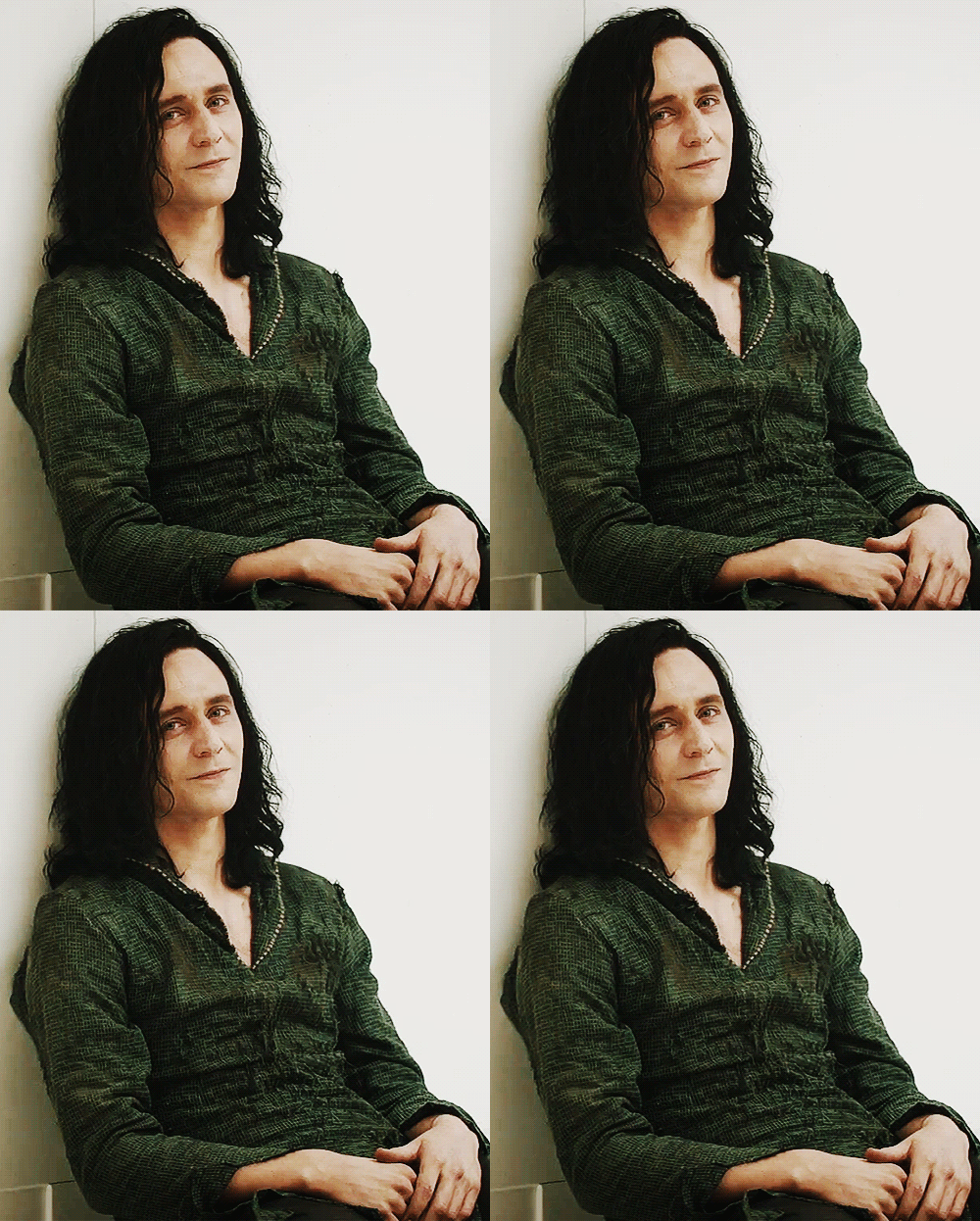


Anyway, Wiccan is able to ascertain the involvement of something mystical when Loki, in a nearby cell, opens his big mouth and tries to make a deal with the team. Everyone banters back and forth a bit, Wonder-Man tries to encourage Loki with some less than savory torture-type stuff, which Iron Man disproves of, and things come to a close when Dr. Strange erects a force-field that prevents any sort of communication between the parties and Loki. No one speaks with Loki, apparently.

Tigra sniffs out some Asgardian influence on the cell, and the session wraps up there.

My Reactions:

Initially, my reactions to this session were very positive, but as the week wore on, my feelings sort of coagulated and became mixed. Hind-sight is 20-20, they say. That being said, I'm going to go over the positives first, and then discuss the things that sort of mixed and soured in my mind.

The Stamford Incident played out very well, I think. It gave everyone a chance to see the gravity of what happens when heroes fail or aren't there to prevent disaster, and it was cool to see the emotional toll along with the various creative ways to coordinate the rescue effort. I even managed to squeeze out some genuine character interaction between Wolverine and Iron Man which went off rather well, in my own humble opinion. Seeing that this group is not really accustomed to that sort of thing... I felt that if I wanted it in the game, I needed to take some initiative, so I did.

(Running out of Moon Knight pictures! >.<)

I also thought the Moon Knight fight scene played out really well. Mechanically, it was interesting to see how formidable a 'villain' can be when played by a player, especially with an optional, forum-rule that, during PVP, a player being acted against gets first dibs to opportunities. While I don't agree with that ruling, it certainly made things interesting and worked in this particular instance. The Moon Knight sub-plot is rather entertaining, all things considered, and I'm glad it showed up.

Finally, on the positive side of things, everyone continues to be great players. Good ideas, funny moments, the whole she-bang. We have a pretty awesome group.

This session wasn't perfect, however, and some things are really being brought into light in my mind that should be elaborated on.

First of all, I would like to talk about troupe-play. It was an optional way to run the game, as outlined in the beginning of the Civil War book, and for those of you not in the know, basically says that you can have multiple characters, swap 'em out, and share XP/PP between them as you go along. My guess is that the designers supposed that, with an event like Civil War, people are going to want to play it from various angles, particularly Pro-Reg/Anti-Reg with different heroes. This sounds pretty good on paper.

In execution, at least from what I'm seeing, it makes things a cluttered jumble, especially with a group size that we have and the set-up that's going on. We have so many heroes in this event right now, and the how's and why's of their presence and involvement are becoming lost to me. Initially, the justification was that this was the entirety of the Avengers, which, at about fourteen heroes is still a bit of a stretch, but it worked. Now that the GM has opened up a third slot with a wider range of options, things are breaking down in my head at the overall narrative. For example, a group of our players have taken Young Avengers characters, which is helpful that they have a reason for sticking together. Some of them showed up to help at Stamford. They apparently arrived separately, which doesn't make sense to me considering they are a team, and what about the rest of the Young Avengers...? More puzzling still, in the prison for mystical stuff, Wiccan is brought along without the rest of his group, even when Kate Bishop would probably want to see Hawkeye. Since the transition between scenes is pretty much dealt in the way of, "So-and-so contacts so-and-so about such-and-such, who's coming?", the logic and justifications start to break down in my head.

Now, granted, this is comic books. People show up in random places for no reason all the time, both of my characters included. How many series is Wolverine in now? And every single event with multiple heroes has Spider-Woman show up in the initial 'Everyone's here!' panel, and she proceeds to do nothing after that. I get that. My question becomes this: does every scene need every player involved in it? I bring this up specifically because of my situation. I haven't selected a third character yet. With Spider-Woman under a building, Wolverine was my only option for the final scene, but narrative would state that he is hunting down Nitro, on his own, right now. Why would he give a shit about how Master Pandemonium escaped? It was a question of, 'Do I want to be the one left out, or do I want to stick with what my character would narratively do?' I went with the first, and regret it, since he didn't do anything in that scene.
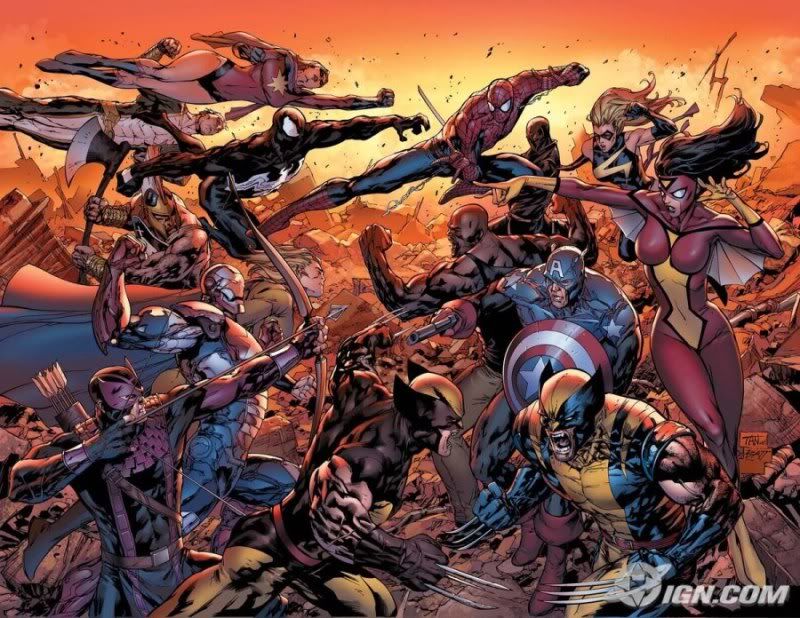
(See?! There she is! Pointing!)

The final issue with troupe play, especially with this many involved, is character development. With potentially twenty-one heroes in the works here, there is almost no room for it to happen to every character, and it makes it more difficult for individual characters as well. How can I complete the arc I had in mind for Spider-Woman, where she makes a good friend before the whole Civil War thing erupts and has to make a very hard decision about where she stands (as detailed in my milestones), when there is almost no inter-character interaction beyond the business at hand, and people are shifting around so much that relationships can't grow? And, when I tried to inject some of this sort of emotional stuff between Iron Man and Wolverine, it felt awkward to ask for, and was sort of ignored in the entire scheme of things.

I'm not asking for the spotlight, if that is what you're thinking. By no means should Wolverine or Spider-Woman be the stars of Civil War. All I'd like to do is create some character arcs that enrich the game, so that when the big action stuff blows up, it has weight beyond, "X amount of people died/stuff got blown up." I dunno. Maybe I'm asking for too much. Maybe I should just flow with the majority and forget about adding some depth in the way that I am. Curse my writing and acting sensibilities.

The second point has to do with some narrative order of operations and focus. In my humble opinion, Stamford should have been the last scene in the evening's line-up, and the other two scenes should have been dealt with first. I understand that the GM has some sub-plots he is trying to saddle onto Civil War, and this is perfectly reasonable, and even encouraged. However, when you are dealing with the 'inciting incident' of your entire plot, you need to focus on it, make it punch, make it matter. Steps to do this were taken, true, but having scenes afterwards/during that were in no-way related to your inciting incident weakens it. I already mentioned how Wolverine didn't give a shit about how Master Pandemonium escaped. In light of a huge tragedy that took a major emotional toll on the characters involved (according to the stress inflicted) and will start a media avalanche that leads to registration, I don't really see why the other characters would give a shit about that either.


As I said in a previous session report that got into deep discussions like this one did, I want to just put in the disclaimer here at the end that I am still enjoying myself in this game, I think the GM is doing a wonderful job juggling seven players and trying to tell a cohesive story, and I think all of my fellow players are great. Like anyone, however, little things bother me, and I wanted to bring them to light, as much for myself as others.

I hope you enjoyed this post. If not, here's a funny picture. (I actually remembered it this time!)

-Wes


Sunday, June 30, 2013

Action's Missing Element

Hey, readers!

Before we get going into the meat of this editorial of sorts, I am here to tell you that this is a sister article to an early post entitled "Why Do People Still Enjoy Action?" If you have not read through that piece yet, please go to the right and read it quickly before delving into the stuff here, since this is a sort-of spiritual follow-up.

With that being said, let's dig into the meat of my revelations.

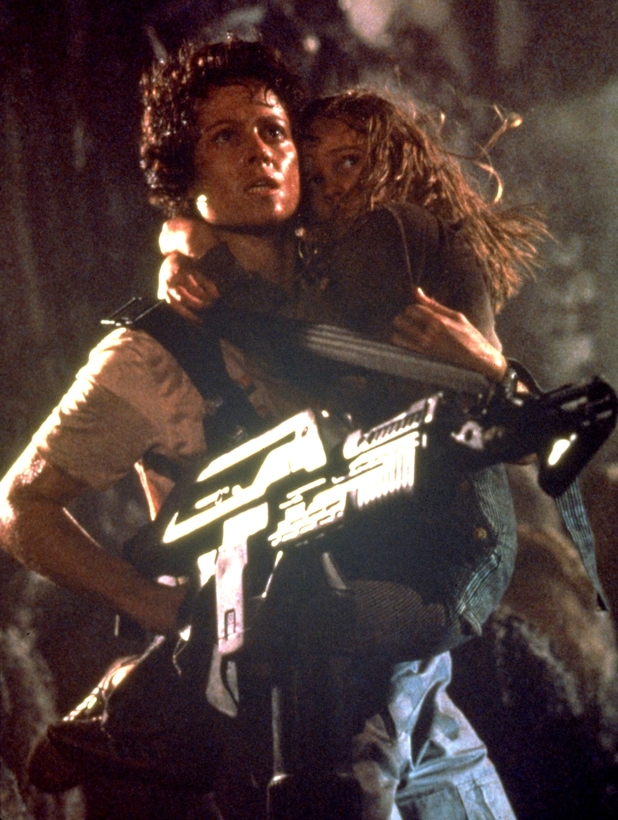
I was flipping channels, as I typically do during afternoons when I am bored and have already watched all of my recorded stuff, and I stumbled upon the climax of Aliens.  Having loved this film and its predecessor, I decided to catch the end where Ripley and Newt scramble through the station to escape its detonation, being chased by the Alien Queen. Even though I was catching it at the end, I felt myself very engaged with what was going on, and instead of flipping to something else, I stayed until the credits.


After turning my brain back on, I realized something.

Aliens is almost as iconic as you can get as far as action movies are concerned, and even after seeing it many times, I was not bored. I was excited. I cared about these characters and what was going on, even after just jumping in, and it was the mind-numbing action that I railed against in that last article.

In fact, some of my favorite movies have heavy amounts of action, such as Star Wars, or the Matrix. Despite the fact that these are now considered classics, there has to be something there that makes the action feel fresh every time instead of the recycled, explosion-heavy bad-assery that seems to have dominated action films this past decade or so.

So, what's the missing element? And is it also missing in our roleplaying sessions?

I've figured it out, and it's rather simple.

Tension; that's the missing element.

The three movies I've mentioned above work tension into their films almost flawlessly at just the right moments, making the action engaging and generating care for the characters if you liked them enough. In Aliens, Ripley may have her awesome gun, but she knows that both she and Newt are toast if the Alien Queen catches up to them, and the audience knows it too. In Star Wars, the Rebel Alliance is about to get their base destroyed by the Death Star, and they only have one shot to do an incredibly tricky maneuver against a huge amount of opposition. I still get goosebumps during the trench run. In the Matrix, everyone (except Neo, but we don't find that out until the end) are basically powerless to stop the Agents, so whenever they show up, the main characters are in serious trouble.


(Minor summer movie spoilers ahead for Star Trek: Into Darkness and Man of Steel)

Now let's contrast these elements against a few of the big summer blockbusters that are making their run this year. Was there tension in Star Trek: Into Darkness? At points, yes, but that is cheapened quite a bit when the back of your mind is reminding you constantly, 'They can't kill off Kirk. That would end the franchise. How are they gonna bring him back?' What about Man of Steel, which is likely going to be the highest grossing action film this year next to Iron Man 3? Well, it's kind of hard to feel tension when two incredibly super-powered people are punching each other through buildings with little regard for those who get in the way. That's not to say they didn't try, what with the 'Kryptonite-esque' aspects of the big planet-terraformer machine, but if memory serves, that didn't slow Superman down all that much.

Let's bring this back to roleplaying, shall we?

To me, it seems that GM's often sit in either one of two camps. Either they are looking to make everything as challenging as possible to compete with the players in some magnitude, or they are rather lenient, hold back, and put the story first. Are there some that sit between them? Undoubtedly, there has to be, but that is the breakdown I often see.

(This also depends highly on what system you are running, but I'm going to assume the lowest common denominator here. If you are running something ala Call of Cthulhu, your tension problems are taken care of by nature of the system itself.)

More often than not, I'm sitting in the second camp, but honestly? I don't want to anymore. That's because of this book.


I really don't want to steal this guy's thunder by reiterating everything he says in this book, but let me present this to you. Do you want action that is meaningful? Do you want your players to be engaged? Do you want to put the missing element of tension inside your games again, make them feel more alive?

Follow this man's advice: play dirty. Push your player characters to the limit. Provide consequences! While it may seem like an assholish way to run games at first, the rewards are incredible, and in the end, your players will thank you if they give enough of a damn.

I know I'm not providing a lot of my own advice on how to interweave tension into your games, but that is because I cannot do it better than this man has done. My goal is for your to walk away with two things: to think about how vital tension and suspense is to meaningful action, and to consider finding a way to read this book. It's that good.

I hope you enjoyed this semi-follow-up! If not, here's a funny picture.

-Wes


Friday, June 14, 2013

Why Do People Still Enjoy Action?

Hey, readers!

So, I just came back from seeing Star Trek: Into Darkness. No, the date isn't wrong. Yes, I am seeing it a few weeks after release. Unfortunately, I'm about a two week delay on my summer movies, seeing as my brother watches them all with his friends and my father and I like to see them together so we wait for a time that is good for both of us.

It was a good movie, all things considered. Story wasn't awful, characterization was strong, and it had some fun moments. Still, walking out of the theater and discussing things with my father, I couldn't help but ponder this question.

'Why do people still enjoy action?'


I mean, at the beginning, the appeal is obvious. Action allows you to experience things that you'd never experience in an out-of-body sort of way. You can be in the middle of a tense fire-fight, escape explosions, fly a ship around, mow down enemies with an automatic weapon, all without any of the real danger. It's exciting.

At least, it's supposed to be.

It's not for me. I'm tired of action. In this violence saturated culture where you can live out any fantasy by popping in a movie or playing a video game, I feel like I've been through it all. I've fought zombies, flown spaceships, beat the bad guy down with my bare fists. There's only so many elements or variations that you can throw on it, but in the end, it's all the same. I don't get excited from action anymore.

Why am I in a minority here?

Since this is a role-playing blog, let's bring it back to my favorite hobby. The majority of RPG's have a focus on action. In fact, you can usually tell how combat driven a particular system is by how much of the core rule-book is taken up by rules on how to handle conflict. Look at a book like D&D, it's usually a pretty solid chunk. A World of Darkness book? Not so much.

I'm just curious as to the why here. Why do people enjoy a game of D&D that's just a constant kill-fest to find better treasure? So, your character kills an orc in a cool way, then another one. He jumps off a building and slices a guy. Maybe he drives a cart into an army and scatters his opponents, sword in hand, plowing away. I can see how that can be fun or cool for a little while, but eventually it becomes a contest of 'who can be the biggest badass' that drags on and on.

Why do people need action to jump-start the game or bring excitement into a session? There's that old trick of introducing ninjas for no reason when the plot gets slow, but why is that necessary? Isn't drama and human emotion engaging enough? Hell, stage-plays are almost entirely comprised of drama, emotion, character depth and growth. That keeps an audience engaged and entertained for the span of the production. Why do things like role-playing games and movies have to bring physical action into the picture to garner interest all the time?
I wish I knew why I was wired different. Many of my friends do not seem to mind combat heavy games with little regard to rhyme or reason. Only a few people agree with my point of view that I know of, and those people are mostly women. Go figure.

Still, I would love an answer. Why do you still enjoy action? Why does it take combat to get you interested or engaged during a session?

For me, I want to move on. I want to leave the mindset of 'My character does this 'cause it's cool, fun, or funny,' and start to explore why my character does what they do, what the consequences are, how they change my character, and how that changes the story. Not to say that action or combat doesn't have a place, it does! But I want it to mean something.  The choice to kill someone should have deep personal and external repercussions, not just he was bad, now he's dead. My character should be doing something beyond the motivation of 'I want money' or 'This is my job.' If my character fails, it should mean something more than just 'Game Over.'


Even if you don't agree with me, I challenge you GMs out there (and myself!) to think outside the combat box when designing your sessions. There are other ways to engage people. Not everyone has the same tastes, and your game design should be diverse to cater to the people you are running it for. If your group is full of people who can't get enough of mindless combat, then keep providing it for them. Just keep in mind the people like me who would prefer something else.

If you have an answer to the main question or any of those above, please, please, tell me! I want to understand this position that is not my own so that I could be a better GM and expand my own point of view. Also, if you agree with me or want to explore the same things that I want to, let me know! Maybe we can gather some like-minded people and do... Something!...

Regardless, I do hope you enjoyed this rant. If not, here's a funny picture.

-Wes

Sunday, June 2, 2013

First Sessions

Hey, readers!


With a first session of a campaign coming up this week, and a few that I'll be running within the month, my mind has been meditating on beginnings. Beginnings of campaigns in particular, but also beginnings in general.

Everything has a starting point, not only works of fiction, but life, stages of life, relationships, projects. The list goes on. Sometimes the starting point is buried in the dust, forgotten, or seemingly insignificant, but it is always the most important piece. Without it, nothing would be.

I don't mean to get weirdly philosophical on an RP blog, but it's something to knock around the noggin a little bit.

So, let's take a look at the beginnings of campaigns. How do first sessions usually go? Where do they start? What sorts of opening scenes work best? Is there criteria for judging whether or not it should be continued for another session?

Stuff like that.

From my personal experience, where a campaign starts really depends on the group's preparation before hand. Is everyone coming in with characters they created on their own or with the GM? Has this group met before hand to discuss anything? Have they even met before? Did the GM set any sort of guidelines? These are the variables that determine really where you can jump in.

Most groups, I've noticed, are cobbled together from whatever characters the individuals wanted to play with little connection to one another that are thrown together as a consequence of circumstance or because of one common link. Therefore, a beginning session's first job in this sort of scenario is to find a way to force these potentially dissonant characters together to do something, usually follow the plot-train that the GM has set tracks for. Either that, or the group is thrown under a common banner, 'Adventure Party', 'Mercenary Band', what have you, and you work under the assumption that you all just work together. To adventure. Or make money. Or something.

The beginnings to this kind of campaigns are usually rather classic and quaint. An old man in the tavern gives your adventure party a quest or mission to find the macguffin, save the macguffin, or defeat Lord MacGuffin the Scotsman. You are all in prison, and there's a prison riot or break and you can only escape by working together. The transport you all are riding is under attack and you are the only able-bodied, combat-ready people in the area. There's a bank robbery and you are the only superheroes in the area because the main ones are in space.

(We've all met this guy)

You get the idea.

And, if this sounds like every campaign you've ever been in, that's fine!

But, there is another way. In my opinion, it's a better way, but that wholly depends on preference, your group, and the game you are running, of course.

My favorite RP podcast is called 'Fear the Boot', and they have come up with something called the 'Group Template.' This is a basic document that outlines clearly what the group is, who they are, how they are connected, and what their goals are. They fill this document out before every campaign, and they create their characters together. If I remember right, they don't come to the table with solid concepts in mind. The GM sets some guidelines, and the group creates and envisions their characters together while creating connections along the way and setting up a reason for being together and goals.


I will tell you from experience, this radically changes the quality of every first session I have ever ran.

Like, literally, day and night.

Now a GM is not confined to slapping together characters that don't work following a plot train that may not even be suited for the group. You can have any beginning you can think of without having to rely on cliches in order to bring the party together. Sure, there are plenty of cliches that can still be used, such as the group summon by an important figure, but you can think outside the box a little. Say the group template is a bunch of professional thieves, each having their own specialty. You can start the campaign in the middle of a heist! Set up some parameters, and the characters will do their own thing because they have goals and the skills to meet them. Maybe something goes wrong, an inciting incident of sorts, and the characters will be motivated to follow up on it because it had to do with something they were striving for on their own initiative, not because some important NPC said that they should care.

Just something to think about.

So, whether the group is cobbled together or nitpickingly planned to the last detail, the first session is here. How to begin? What is Act 1: Scene: 1?

Again, there seems to be a split in tactics, one I prefer and one I like a little less. It usually boils down to whether it starts with action or starts with drama.

Since I like the X-Men so much, let's use them as an example.

Does the campaign start with a Danger Room session, or a scene where they are debating mutant rights before congress? Is someone attacking the mansion after the Danger Room, or assaulting the congressional meeting? Does someone's powers freak out at the wrong time and cause something terrible to happen?
These are all ways an X-Men campaign could start, potentially.

Is it better to start out with action or drama? Both?

I can see great justifications for both, which I elaborate on here.


Start out with an action scene if the group is not completely familiar or comfortable with the rules. Since most of the rules cover how to handle moments of action, this is a great place to clear up any misconceptions and make sure everyone knows how to play. It could also engage players who are more combat inclined and get them interested from the get-go as opposed to having them set through dialogue, which they'd rather not do. Inciting incidents are also great in the middle of action scenes, and it's a wonderful way to give everyone a little glimmer of spotlight before the plot train begins moving.


However, start out with drama if you want your players to be comfortable in their own character's skins and create inter-group relationships early on. It doesn't even have to be anything terribly dramatic. Hell, I love starting campaigns at a point where it's a party. How does your character interact in a surprise party for another character? Or a fancy dinner? This gives the players a chance to get a feel for how their character acts, interacts, talks, feels, etc. It can also be a great place to set up themes, tones, motifs, and other things that will make sense or be significant later on. However, don't linger too long if you have player's who are action minded, or else they will probably be terribly bored.

You can probably tell that I favor the second option, but that's just because of how I run games and how I like to play.

And there's no reason you can't mix the two, a little drama before the action, a little action after the drama. In fact, that is usually the best way to please everybody involved.

So, first scene is over, we're in the thick of the inciting incident, and the session is going to wrap up soon. What sorts of things are you as the GM going to be looking for? What are you as a player expecting by the time the dice are collected and everyone shuffles into the driveway or goes to play video games?

As a GM, I would look for the following things to see if the first session was a success:

-Did everyone get a moment to shine?
-Does everyone understand the setting?
-Does everyone understand their character?
-Was there enough to leave them wanting to come back for more?

And most importantly...

-Did we have fun?

As a player, I would consider the following things to see whether I'd play again:

-Did I like the other players? (Because, if you didn't, you probably shouldn't game with 'em)
-Did the GM try his best? (Because no one's perfect, but sometimes you've just got a bad apple)
-Am I engaged/interested at all in what's going on in the plot, or in the characters? (Because, if not, that should be fixed)

And most importantly...

-Did I have fun?

You can debate all you'd like on that criteria, but that is what I usually mentally go through after a first session, and that's important, because first sessions can sometimes make or break a campaign. Sure, you should give it another few sessions or so (time allowing) before making any sort of serious judgement, but sometimes an unresolved issue from session one can bite you in the ass down the road and tank a campaign.

Just sayin'.

Anyway, those are my thoughts on first sessions. It is an interesting beast, to be sure, but like I said in the beginning, they are necessary for gaming to exist. Why not think about 'em a little bit? Maybe try something different?

I hope you liked my thoughts! If not, here's a funny picture.

-Wes